


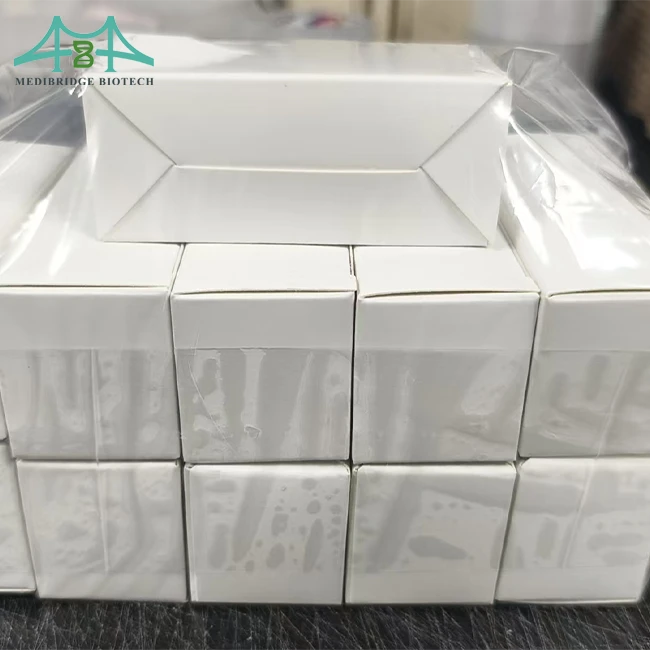
Pancragen powder is a short-chain peptide composed of the amino acid sequence Lys-Glu-Asp-Trp (KEDW). As a member of the organ-specific peptide bioregulator family, it is commonly presented as a white lyophilized powder and is intended for laboratory and biochemical research environments.
In scientific studies, this peptide is often referenced in research related to pancreatic cellular systems and metabolic balance. Its compact peptide structure makes it relevant for experimental models exploring cellular activity, peptide signaling, and biochemical regulatory processes associated with pancreatic tissues.
Shaanxi Medibridge Biotech Co., Ltd. supplies research-grade peptide raw materials to laboratories, universities, and scientific institutions worldwide, providing reliable purity standards and stable batch supply.
COA
|
|
||
|
Product Name |
CAS Number |
Batch Number |
|
pancragen powder |
N/A |
MB2601261030 |
|
Manufacturer Date |
Analysis Date |
Expiry Date |
|
2026-01-26 |
2026-01-27 |
2028-01-25 |
|
Sample Qty Base |
Packing |
Test Method |
|
3.85KGS |
10GS/bottle |
HPLC |

|
Item |
Standard |
Results |
|
Appearance |
White lyophilized peptide powder |
Conforms |
|
Identification (HPLC) |
Retention time consistent with reference standard |
Conforms |
|
Peptide Sequence |
Lys-Glu-Asp-Trp (KEDW) |
Conforms |
|
Molecular Formula |
C26H36N6O9 |
Conforms |
|
Molecular Weight |
~576.25 |
Conforms |
|
Purity (HPLC) |
NLT 98.0% |
98.62% |
|
Solubility |
Soluble in water |
Conforms |
|
Water Content (Karl Fischer) |
NMT 5.0% |
2.33% |
|
Acetate Content |
NMT 12.0% |
6.41% |
|
Heavy Metals |
NMT 10 ppm |
Conforms |
|
Related Substances |
NMT 2.0% |
Conforms |
|
Microbial Limits |
Complies with laboratory reagent standards |
Conforms |
|
Storage |
Store in cool & dry place. keep away from strong light and heat |
|
|
Conclusion |
The batch conforms to the IN-HOUSE standard |
|
|
|
||

Mechanism / Biochemical Characteristics
Peptide Interaction with Cellular Components
Short regulatory peptides are widely studied for their potential ability to interact with cellular macromolecules such as DNA and chromatin structures. Due to their small molecular size, these peptides may be capable of entering cells and participating in molecular interactions that influence intracellular regulatory environments.
Influence on Pancreatic Cellular Regulation
In experimental models, peptides of this class are frequently investigated for their association with pancreatic cellular systems. Research discussions often focus on their relationship with regulatory processes involved in cellular activity, differentiation, and maintenance of pancreatic tissue function.
Role in Peptide-Mediated Signaling Pathways
Short-chain peptides are also explored for their potential involvement in intracellular signaling networks. Studies typically examine how peptide-based regulators may contribute to biochemical communication between cellular components, supporting broader investigations into metabolic and tissue-related signaling pathways.

Potential Application Areas
Pancreatic Cellular Research
Pancreatic regulatory peptides are commonly studied in laboratory models focusing on pancreatic cellular systems. Researchers often explore their relevance in experiments related to cellular activity, tissue organization, and biochemical environments associated with pancreatic structures.
Metabolic Regulation Studies
Peptides associated with pancreatic systems are frequently referenced in research involving metabolic balance and cellular metabolic processes. Experimental models may examine their role within studies investigating biochemical pathways linked to metabolic signaling.
Molecular and Biochemical Experiments
Short-chain peptides are widely used in biochemical and molecular biology experiments. Their defined amino acid sequences and stable structures make them suitable for studies exploring peptide behavior, cellular interactions, and regulatory molecular systems.
Peptide Bioregulator Research
As part of the peptide bioregulator category, this compound may also appear in broader investigations examining organ-related peptide regulators. These studies typically focus on understanding how small regulatory peptides participate in biological signaling environments within laboratory settings.

Solubility and Handling
Solubility
This peptide is generally soluble in sterile water and commonly used laboratory buffer solutions. For research preparation, it may be dissolved in sterile water, phosphate-buffered saline (PBS), or other compatible aqueous buffers depending on experimental requirements. Gentle mixing is recommended to facilitate complete dissolution.
Handling
For laboratory handling, it is recommended to prepare solutions under sterile conditions when required by experimental protocols. The peptide solution should be mixed gently to avoid unnecessary agitation. Researchers may prepare working solutions according to their specific experimental concentrations and handling procedures.

Storage
The lyophilized peptide should be stored in a cool and dry environment away from direct light. For long-term stability, it is recommended to keep the product at −20°C or below in a sealed container.
Once reconstituted, the peptide solution should be stored at 2–8°C and used within a reasonable period according to laboratory requirements. To maintain stability, repeated freeze–thaw cycles should be avoided whenever possible.
For optimal preservation, aliquoting the prepared solution into smaller volumes before storage may help maintain peptide integrity during experimental use.

Specification / Our Advantages
2.Batch-to-batch consistency and stable long-term supply capability
3.Lyophilized powder form for convenient laboratory preparation
4.Flexible customization options for packaging and specifications
5.Efficient logistics and international shipping support
6.Professional peptide manufacturing experience and technical assistance
7.Reliable communication and responsive customer service

Package Options
This product is available in several standard research packaging sizes to accommodate different laboratory requirements. Common package options include 10 mg, 50 mg, and 100 mg quantities supplied as lyophilized peptide powder.
For research projects requiring specific quantities or packaging formats, customized options may also be available. Additional services such as vial labeling, bulk packaging, and tailored quantities can be arranged according to laboratory needs.
All products are packaged to maintain stability and product integrity during storage and transportation.
FAQ
Q: What is Pancragen powder used for?
A: Pancragen is a synthetic peptide used in laboratory studies investigating peptide-mediated cellular regulatory mechanisms.
Q: What is the purity level of this peptide?
A: The product is typically supplied with a purity level of NLT 98% as verified by HPLC analysis, ensuring suitability for laboratory and biochemical research applications.
Q: How should the peptide be dissolved for laboratory use?
A: The lyophilized powder can generally be dissolved in sterile water or compatible laboratory buffer solutions depending on the experimental requirements.
Q: What storage conditions are recommended?
A: For long-term stability, the lyophilized peptide should be stored at −20°C or below in a dry and sealed environment.
Q: Are custom packaging or quantities available?
A: Yes. Customized quantities, vial packaging, and labeling options may be available depending on specific research project requirements.
Hot Tags: pancragen powder, China pancragen powder manufacturers, suppliers, factory, Pancragen Powder, Cortagen Powder, Livagen Powder, Bronchogen Powder, Ovagen Powder, Cardigan Powder


