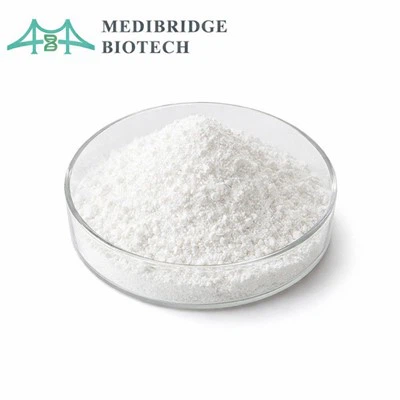
Climbazole Powder also known as climbazol, has the chemical name 1-(4-chlorophenoxy)-1-(1H-imidazole-1-yl)-3,3-dimethyl-2-butanone chloromethyl ketone, which is a synthetic chemical component. It is made by reacting chloromethyl ketone, imidazole, and toluene as raw materials and then undergoing processes such as crystallization, filtration, decolorization, and drying. It inhibits the manufacture of ergosterol, a crucial component of fungal cell membranes, which is how it kills fungi and possesses good antifungal qualities. It can kill ovoid spores and pityriasis tinea, inhibiting and eliminating dandruff and relieving itching. Due to its stable nature and poor solubility in water, it will not irritate the scalp and can also inhibit Candida albicans, which cause oral gingivitis and periodontitis. Therefore, it is an essential functional additive for daily chemical products and can be widely used in shampoo, conditioner, shower gel, soap, toothpaste, mouthwash, etc. Climbazole can also be used to make medications for eczema and to treat fungal infections of the skin.
Shaanxi Medibridge Biotech Co., Ltd. focuses on the supply of pharmaceutical raw materials and research-use compounds. We support customers with stable quality, clear specification communication, flexible packaging options, and document-related support for different project stages.
COA
|
|
||
|
Product Name |
CAS Number |
Batch Number |
|
Climbazole Powder |
38083-17-9 |
MB2608121659 |
|
Manufacturer Date |
Analysis Date |
Expiry Date |
|
2026/8/12 |
2026/8/13 |
2028/8/12 |
|
Sample Qty Base |
Packing |
Test Method |
|
600GS |
10GS/bottle |
HPLC |
|
|
||
|
Item |
Standard |
Results |
|
Appearance |
White crystalline powder |
Conforms |
|
Solubility |
Soluble in water |
Conforms |
|
Assay |
≥99% |
99.19% |
|
Loss on drying |
≤2.0% |
1.25% |
|
Heavy metal |
≤15ppm |
Conforms |
|
As |
≤2.5ppm |
Conforms |
|
Pb |
≤2.5ppm |
Conforms |
|
Hg |
Negative |
Negative |
|
Total plate count |
≤1000cfu/g |
102cfu/g |
|
Yeast&Mold |
≤100cfu/g |
Conforms |
|
E.Coli |
Negative |
Negative |
|
Salmonella |
Negative |
Negative |
|
Conclusion |
The batch conforms to the IN-HOUSE standard |
|
|
|
||


Antifungal Mechanism
Climbazole's antifungal activity is associated with inhibition of ergosterol synthesis. Ergosterol is an important component of fungal cell membranes, supporting their structure and function. Disruption of its synthesis can affect fungal growth and membrane-related processes. An original study investigating climbazole also identified inhibition of ergosterol synthesis as the basis of its antifungal activity.
Mechanistic investigations of imidazole antifungals commonly examine sterol 14α-demethylase, or CYP51-related processes. However, the precise target interactions in a particular Malassezia strain should be verified experimentally rather than inferred solely from the compound's chemical class.
Useful endpoints include sterol composition, ergosterol content, sterol intermediates, membrane integrity, and fungal viability.

Scalp Microbiome and Anti-Dandruff Research

Climbazole can be used to investigate relationships among Malassezia, the scalp environment, and dandruff. Evaluation should combine microbial measurements with scalp assessments rather than treating reduced fungal abundance as a complete measure of anti-dandruff performance.
Relevant endpoints include flaking scores, redness, itching, sebum levels, stratum corneum hydration, and transepidermal water loss. Microbial methods should also be distinguished: culture, qPCR, and other techniques measure different aspects of microbial presence. Changes in DNA signals are not necessarily equivalent to changes in viable fungal counts.
Combination Research: Comparative Activity and Synergy
Climbazole can be investigated alongside other anti-dandruff or antifungal ingredients. A preliminary study published in 2024 evaluated climbazole-containing formulations and combinations with piroctone olamine. Under the tested Malassezia conditions, selected formulations produced effects comparable to those of a reference shampoo containing 2% ketoconazole.
Improved activity in a combination does not necessarily demonstrate synergy. Establishing synergy requires concentration matrices, an appropriate model of additive activity, and reproducible results. Finished-product comparisons should also control surfactants, pH, solvents, and contact time.
Stronger activity may reflect changes in solubilization, delivery, or retention rather than an interaction between the ingredients at their molecular targets. Antifungal performance, formulation stability, and local tolerability should therefore be assessed together.

Analytical Methods and Quality Control
Quality assessment of Climbazole Powder should cover identity, quantitative content, impurities, and stability.
|
Assessment |
Suitable analytical approach |
Purpose |
|
Chemical identity |
Appropriate combinations of IR, NMR, and LC–MS |
Confirm structure and exclude incorrect material |
|
Assay |
Validated quantitative HPLC or UPLC |
Determine active-ingredient content |
|
Related substances |
Chromatography with adequate separation |
Monitor process impurities and degradation products |
|
Water and residual solvents |
Karl Fischer and appropriate GC methods |
Support content calculations and batch comparisons |
|
Solid-state properties |
DSC, XRPD, and particle-size analysis where relevant |
Investigate dissolution and crystallization differences |
|
Finished-product content |
Methods with validated extraction recovery |
Address formulation-related measurement bias |
Safety, Endocrine-Related Research

Safety assessment should consider local irritation, sensitization, skin absorption, and systemic exposure. Raw material and finished products, rinse-off and leave-on applications, and individual versus combined product use require separate consideration.
A 2024 original study used H295R cells and hormone-receptor reporter systems to investigate climbazole's effects on steroidogenesis and related pathways. Under its experimental conditions, decreased secretion of testosterone and estradiol was observed from a climbazole concentration of 0.3 μM.
This represents an in vitro hazard signal requiring exposure-based interpretation. Concentrations in cell-culture systems cannot be equated directly with human tissue concentrations following shampoo use. Risk assessment also requires information on actual exposure, absorption, metabolism, and dose–response relationships.
FAQ
What is Climbazole used for?
Climbazole is a topical antifungal agent primarily used to treat and prevent scalp and skin fungal conditions, most notably dandruff, seborrheic dermatitis, and scalp eczema.
Is Climbazole safe to use?
Climbazole is safe for human health when used in approved cosmetic concentrations.
Is Climbazole good for hair growth?
Climbazole is not a direct hair growth stimulant.
What are the potential side effects of taking Climbazole?
Climbazole is generally well-tolerated and rarely causes major side effects when used in approved cosmetic or anti-dandruff concentrations.
If you are looking for a high-quality Climbazole Powder manufacturer with whom you can establish a long-term, stable partnership, then Shaanxi Medibridge Biotech Co., Ltd. would be your best business partner. Don't hesitate to contact us at hi@medibridgeapi.com.
Hot Tags: climbazole powder, China climbazole powder manufacturers, suppliers, factory, cobicistat pharmaceutical raw powder, mirabegron chemical compound, mirabegron drug formulation ingredient, picamilon research compound, prilocaine active compound powder, telmisartan formulation ingredient