




Iodixanol Powder also known as Visipaque, is a non-ionic contrast agent that is widely used in medical imaging, especially CT scans and angiography. Its chemical structure is complex and exquisite, with excellent image contrast and biocompatibility. Its structure is composed of multiple basic structural units, showing a high degree of symmetry and stability. First of all, its core structure is a phthalamide structure consisting of two benzene rings connected by a carbon chain. The two benzene rings are attached to amide groups, respectively, and are connected through carbon chains and hydroxyl groups, forming the main framework of the molecule.
Among them, the iodine atoms on the benzene ring play a role in enhancing X-ray absorption, thereby improving image contrast. In the benzene ring, each iodine atom is connected to a diiodoamide group, and these groups are connected to another iodoamide group through a carbon chain, forming a symmetrical structure of the molecule. In addition, the presence of hydroxyl groups on the benzene ring increases the water solubility of the molecule and contributes to its stability and diffusibility in physiological environments. In the connecting part of the carbon chain, there are hydroxyl groups and carbon-hydrogen bonds, making the molecule highly water-soluble and biocompatible. The presence of these hydroxyl groups also helps the molecules form a stable structure in solution and prevents them from aggregating or precipitating. Overall, its chemical structure is exquisitely designed and combines high image contrast, water solubility, and biocompatibility. Its non-ionic properties make it widely used in medical imaging, providing clear image information while reducing the risk of patients' allergic reactions to contrast agents and providing a reliable tool for clinical diagnosis.
Shaanxi Medibridge Biotech Co., Ltd. focuses on the supply of pharmaceutical raw materials and research-use compounds. We support customers with stable quality, clear specification communication, flexible packaging options, and document-related support for different project stages.
COA
|
|
||
|
Product Name |
CAS Number |
Batch Number |
|
Iodixanol Powder |
92339-11-2 |
MB2608251045 |
|
Manufacturer Date |
Analysis Date |
Expiry Date |
|
2026/8/25 |
2026/8/26 |
2028/8/25 |
|
Sample Qty Base |
Packing |
Test Method |
|
800GS |
15GS/bottle |
HPLC |
|
|
||
|
Item |
Standard |
Results |
|
Appearance |
White Powder |
Conform |
|
Odor |
Characteristic |
Conform |
|
Assay |
≥99.0% |
99.49% |
|
Particle Size |
100% pass 80mesh |
Conform |
|
Moisture |
<5.0% |
Conform |
|
Ash Content |
<4.0% |
Conform |
|
Solvent Residue |
Eur.Pharm |
Conform |
|
Total Heavy Metals |
<10 ppm |
Conform |
|
Arsenic |
<1.0 ppm |
Conform |
|
Lead |
<1.0 ppm |
Conform |
|
Mercury |
<0.5 ppm |
Conform |
|
DDT |
<0.2ppm |
Conform |
|
E. Coli |
Negative |
Negative |
|
GMO Status |
Complies |
GMO Free |
|
Irradiation |
Complies |
Irradiation Free |
|
Conclusion |
The batch conforms to the IN-HOUSE standard |
|
|
|
||


X-Ray Attenuation and Phantom Studies
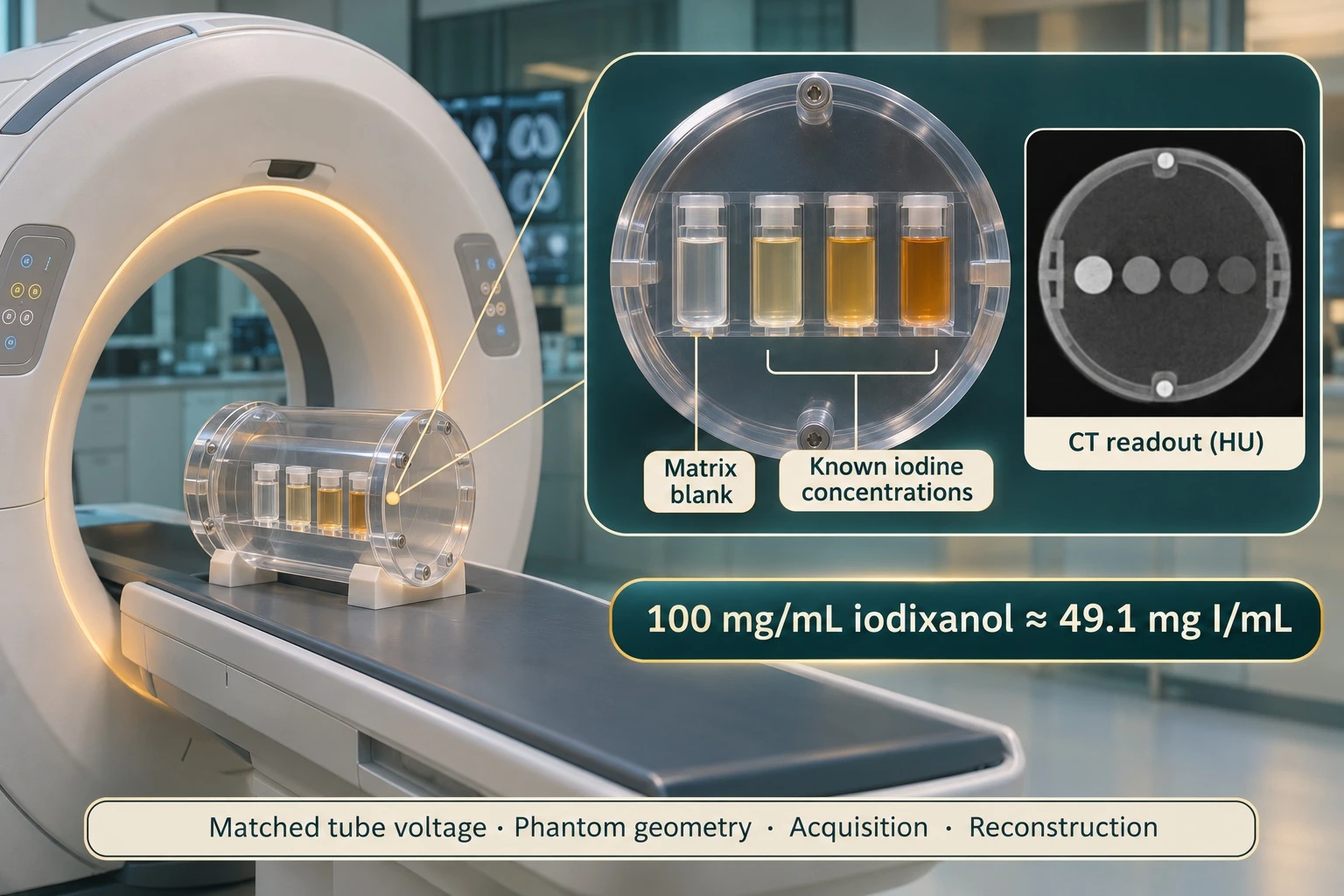
In CT and radiographic phantom studies, iodine concentration is the starting point for comparing iodinated samples. Iodine accounts for approximately 49.1% of the mass of pure iodixanol. On this basis, 100 mg/mL iodixanol corresponds to about 49.1 mg I/mL. Public formulation data use the same convention.
To characterize the relationship between iodine concentration and CT attenuation, prepare a matrix blank and a series of samples with known iodine concentrations. Measure CT values in Hounsfield units (HU) under matched tube voltage, phantom geometry, acquisition settings, and reconstruction parameters.
Solution Density, Viscosity, and Osmolality
Density is mass per unit volume, dynamic viscosity describes resistance to flow, and osmolality measures the concentration of osmotically active particles per kilogram of solvent. Each iodixanol molecule contains six iodine atoms. At the same iodine concentration, iodixanol therefore requires approximately half the molecular concentration of a nonionic monomer containing three iodine atoms. The osmolality of a prepared solution depends on its full composition, including any added electrolytes, and should be measured directly.
The following values apply to two specific formulations described in the U.S. product label.
|
Property |
270 mg I/mL |
320 mg I/mL |
|
Osmolality (mOsm/kg water) |
290 |
290 |
|
Dynamic viscosity at 20 °C (mPa·s) |
12.7 |
26.6 |
|
Dynamic viscosity at 37 °C (mPa·s) |
6.3 |
11.8 |
|
Density at 20 °C (g/mL) |
1.314 |
1.369 |
|
Density at 37 °C (g/mL) |
1.303 |
1.356 |
Density-Gradient Separation and Particle Characterization
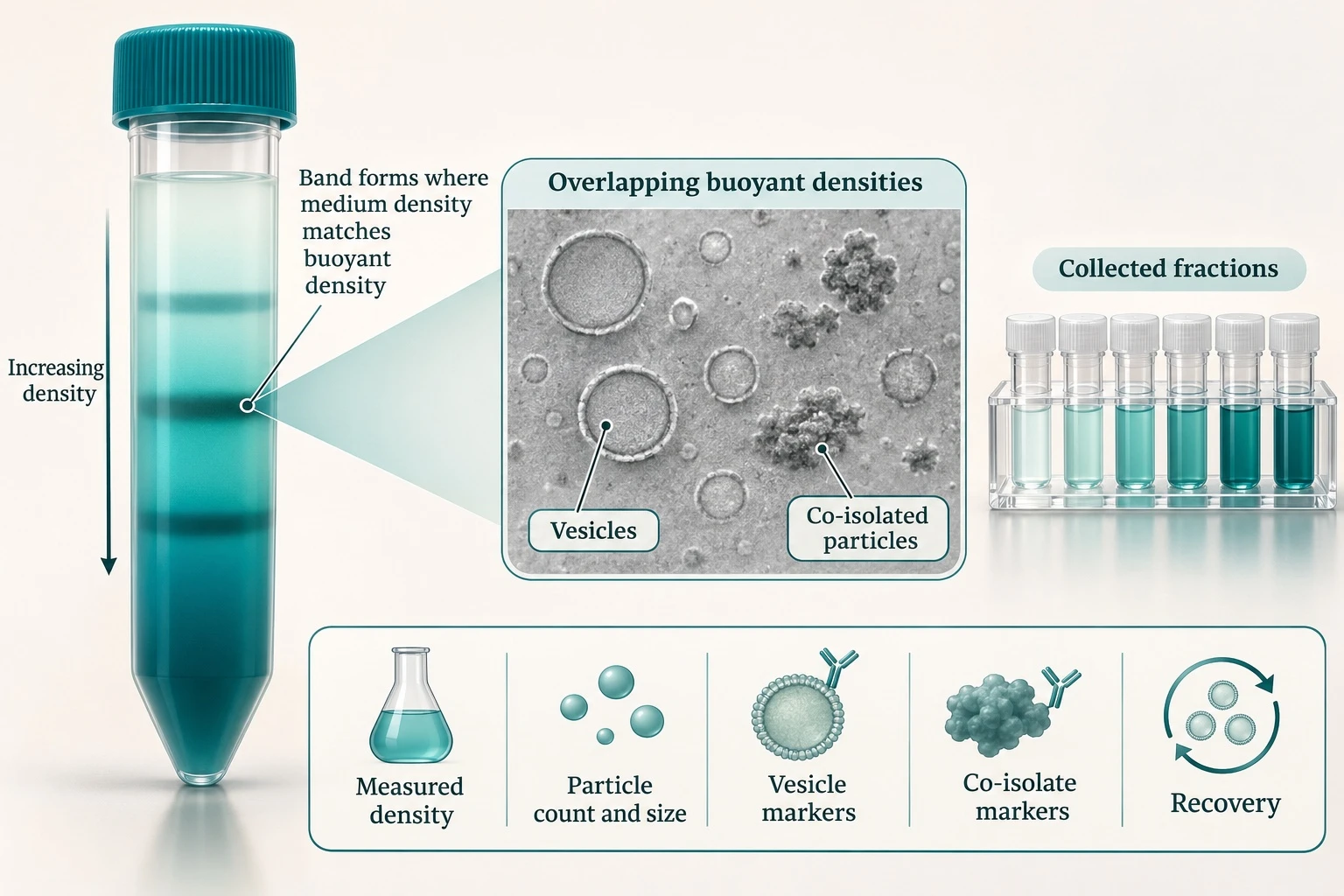
Iodixanol is used as a density-gradient medium in research, including the fractionation of extracellular vesicles (EVs). When an isopycnic gradient reaches equilibrium, particles band at positions where the surrounding medium matches their buoyant density.
For each collected fraction, pair measured density with independent measurements of particle identity and recovery. In EV studies, useful readouts include particle count, size distribution, vesicle-associated markers, and markers of co-isolated material. Particles with overlapping buoyant densities can occur in the same fraction, so band position is most informative when interpreted alongside these measurements.
Powder Identification, Assay, and Impurity Profiling
The public USP monograph specifies an iodixanol assay range of 98.6%–101.0%, calculated on the anhydrous basis. When comparing certificates of analysis or laboratory results, check the reporting basis, analytical method, and reference standard. An anhydrous-basis assay quantifies iodixanol after correcting for water content, whereas chromatographic area percentage describes its share of the integrated detector response under the specified method.
|
Analytical objective |
Suitable approach |
Key readout |
|
Identity confirmation |
Chromatographic comparison with a reference standard, supported by IR or mass spectrometry |
Confirmation of the principal component |
|
Iodixanol assay |
Quantitative HPLC with a reference standard |
Content reported on an as-is or anhydrous basis |
|
Water content |
Karl Fischer titration |
Water content for assay correction and batch comparison |
|
Related substances |
HPLC with adequate resolution, supported by LC–MS where needed |
Separation and assignment of related or newly observed peaks |
|
Free iodide |
Validated ion chromatography or another specific method |
Free iodide measured independently of covalently bound iodine |
|
Solid-state properties |
XRPD, DSC, TGA, or microscopy |
Solid-state profile, thermal events, mass loss, or particle morphology |
Stability and Analytical Method Development

For powder stability, track iodixanol content, related substances, water content, and appearance. XRPD or thermal analysis can be added when changes in solid-state properties are relevant. For solution stability, track measured concentration, pH, clarity, and the chromatographic impurity profile. In concentrated solutions, density and viscosity may also be informative when measured at a consistent temperature.
Controlled exposure to light, heat, oxidative stress, or selected pH conditions can help assess whether a stability-indicating method resolves the iodixanol peak from newly formed peaks.
FAQ
What is iodixanol used for?
Iodixanol (commonly known by the brand name Visipaque) is an iodinated radiocontrast agent used during medical imaging procedures.
Is iodixanol toxic to cells?
Iodixanol is generally considered inert and non-toxic to mammalian cells in many standard laboratory and clinical applications, though its effects depend heavily on the cell type, concentration, and exposure duration.
Is iodixanol the same as iohexol?
No, iodixanol and iohexol are not the same, though both are non-ionic iodinated contrast media used in medical imaging.
What is the chemical structure of iodixanol?
Iodixanol is a non-ionic, iso-osmolar, dimeric iodinated contrast agent.
If you are looking for a high-quality Iodixanol Powder manufacturer with whom you can establish a long-term, stable partnership, then Shaanxi Medibridge Biotech Co., Ltd. would be your best business partner. Don't hesitate to contact us at hi@medibridgeapi.com.
Hot Tags: iodixanol powder, China iodixanol powder manufacturers, suppliers, factory, Cilostazol Powder, cobicistat treatment formulation ingredient, picamilon capsule ingredient, prilocaine active compound powder, telmisartan formulation ingredient, telmisartan synthetic pharmaceutical compound


