


What Makes Phycocyanin Blue?
C-phycocyanin, the form commonly obtained from spirulina, is a pigment–protein complex. Its protein component contains two types of subunit, called alpha and beta. Attached to these subunits is phycocyanobilin, a light-absorbing molecule known as a chromophore. The complex absorbs strongly near 620 nm, in the orange-red region of the visible spectrum. Because it absorbs those wavelengths more strongly than blue light, a concentrated solution appears blue. X-ray crystallography gives researchers a way to examine how the protein holds the chromophores and how its subunits fit together.
How Cyanobacteria Use It to Harvest Light
Inside cyanobacteria, C-phycocyanin is part of a larger structure called the phycobilisome. This structure acts as an antenna, capturing wavelengths that complement those absorbed by chlorophyll. In a typical cyanobacterial phycobilisome, phycocyanin is arranged in rods connected to a core rich in allophycocyanin. When a chromophore absorbs a photon, the excitation energy can pass between pigments toward the photosynthetic machinery. Researchers compare absorption and fluorescence spectra to study this transfer. Absorption shows which wavelengths the pigments capture, while fluorescence provides clues about where the excitation energy goes.

From Spirulina Biomass to a Blue Extract
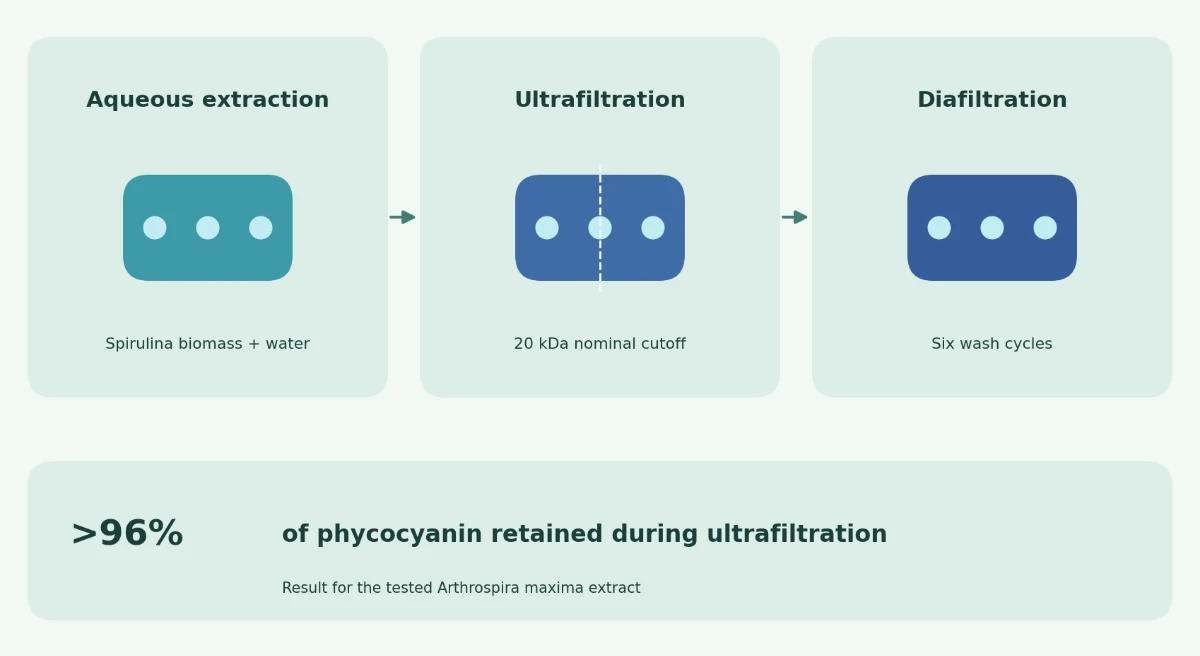
C-phycocyanin is water-soluble, so aqueous extraction can recover it from spirulina biomass. The resulting liquid also contains other soluble material, which researchers can separate using membranes. In one study of Arthrospira maxima, a 20 kDa ultrafiltration membrane retained more than 96% of the measured phycocyanin in the fraction held back by the membrane. The researchers then washed that fraction through repeated diafiltration cycles to remove more of the smaller dissolved compounds. This illustrates two goals of purification. Recovery tracks how much pigment is kept, while enrichment tracks how much cleaner the resulting fraction becomes.
What the A₆₂₀/A₂₈₀ Ratio Actually Measures
Researchers often compare absorbance near 620 nm, where C-phycocyanin absorbs strongly, with absorbance at 280 nm, where many proteins also absorb. The resulting A₆₂₀/A₂₈₀ ratio is a quick indicator of how enriched a preparation is in the blue pigment. In the Arthrospira maxima membrane study, six diafiltration cycles produced an extract with a reported ratio of 1.16. The ratio is unitless. To compare powders by pigment content, researchers need a concentration measurement, such as milligrams of C-phycocyanin per gram of powder, together with the analytical method used to obtain it.


Why Heat and pH Change the Color
The blue color depends partly on the protein environment surrounding the chromophore. Heating or changing pH can alter that environment and reduce the characteristic absorbance. In one study of a spirulina-derived extract, the pigment showed its greatest stability at pH 5.5–6.0 among the conditions tested. The study also reported that roughly 50% of the initial phycocyanin concentration remained after 30 minutes at 59 °C. These results describe the preparation and conditions used in that experiment. When comparing formulations, researchers can track color and absorbance over time at controlled temperatures and pH values.
Why Two Blue Powders Can Behave Differently
Drying turns a liquid extract into a powder, and the ingredients used during drying can influence how that powder behaves when mixed with water. One freeze-drying study compared phycocyanin preparations made with different coating materials, including maltodextrin combined with carrageenan or sodium alginate. For a side-by-side comparison, researchers can record powder moisture, the time required for dispersion, and color after reconstitution. Measuring absorbance at the same pigment concentration helps separate the effect of formulation from the effect of simply adding more pigment. Reporting the coating materials makes the comparison easier to reproduce.

Shaanxi Medibridge Biotech Co., Ltd. is dedicated to supplying a wide range of research-grade products-including peptides, chemical compounds, and extracts-to laboratories, academic institutions, and biotechnology organizations worldwide. If you are seeking a partner for high-purity raw materials to establish a long-term collaboration, please email hi@medibridgeapi.com.


