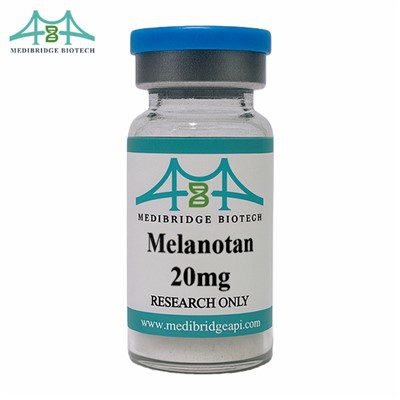
Bremelanotide Peptide (development code PT-141) is a synthetic cyclic melanocortin receptor agonist derived from structure–activity optimization of α-melanocyte-stimulating hormone (α-MSH) analogs. Pharmacologically, it belongs to the melanocortin peptide family and exerts its principal effects through activation of central melanocortin pathways, rather than through direct peripheral vasodilation. This central mechanism distinguishes Bremelanotide from phosphodiesterase type 5 (PDE5) inhibitors, which primarily act by enhancing nitric oxide–mediated blood flow in erectile tissue.
As one of China's top seven Bremelanotide peptide manufacturers, Shaanxi Medibridge supplies Bremelanotide peptide powder with a purity of 99.85%. While many standard laboratories typically achieve around 99.4%, and some smaller non-compliant facilities produce material below 98%, Shaanxi Medibridge is committed to delivering higher purity, tighter specifications, and more consistent batch-to-batch results.
COA
|
Item |
Standard |
Results |
|
Purity |
≥98% |
99.75% |
|
Peptide Assay |
≥80% |
94.14% |
|
Mass Spectrum |
1025.18 |
1026.15 |
|
Solubility |
Soluble in water |
Complies |
|
Clarity and color of solution |
Clear and colorless |
Complies |
|
Sodium salt |
<5.0% |
1.36% |
|
Water |
≤7.0% |
2.51% |
|
Residual Solvent: Methanol |
≤0.3% |
0.0082% |
|
Isopropanol |
≤0.5% |
N.D. |
|
Acetonitrile |
≤0.041% |
0.025% |
|
Methylene Chloride |
≤0.06% |
0.045% |
|
N,N-Dimethylformamide |
≤0.088% |
N.D. |
|
Triethylamine |
≤0.032% |
N.D. |
|
Tert-butyl methyl ether |
≤0.5% |
0.155% |
|
Endotoxin |
≤0.5 EU/mg |
Complies |
|
Microbial Limit |
Total aerobic bacteria <100 CFU/g Total yeast & mold <50 CFU/g |
<50 CFU/g <10 CFU/g |
|
Storage |
Keep in dark and cool dry place (-20 to 8°C) |
|
|
Conclusion |
The batch conforms to the IN-HOUSE standard |
|
|
|
||

Specifications (for research use only)
| Form | Sample Order | Specification |
| Raw powder | 1 g | Purity is NLT 99.96% |
| Vials | 10 vials | 3ml/5ml/7ml/15ml vials etc. |
Scent Profile & Benefits

Bremelanotide Peptide is typically supplied as a white to off-white lyophilized powder and is generally expected to exhibit little to no noticeable odor under standard storage and handling conditions. As a synthetic research peptide, its olfactory characteristics are not considered a primary identity marker or release criterion, but an abnormal or strong odor may indicate possible issues related to impurities, degradation, residual solvents, or inappropriate storage conditions. For research applications, odor should therefore be interpreted only as a supplementary physical observation, alongside analytical data such as HPLC purity, MS identity, water content, and appearance consistency.
From a research perspective, Bremelanotide is valued primarily for its role as a centrally acting melanocortin receptor agonist, especially in studies involving MC4R-related pharmacology, neuroendocrine signaling, and behavioral pharmacology. It is widely used in receptor profiling, GPCR functional assays, and translational studies linking receptor activation to physiological and behavioral outcomes.
Mechanisms of Action
Mechanistically, Bremelanotide is best understood as a centrally acting pro-sexual neuropeptide agent. Its therapeutic effect is not based primarily on direct smooth muscle relaxation or local vascular recruitment, but on the enhancement of central excitatory signaling involved in sexual response. For this reason, its clinical relevance is greatest in disorders characterized by impaired sexual interest or desire, rather than in purely hemodynamic sexual dysfunction.

Tandem Reactions

Bremelanotide is a melanocortin receptor agonist whose pharmacological cascade primarily revolves around the activation of melanocortin receptors in the central nervous system, particularly MC4R. Unlike drugs that primarily improve efficacy through peripheral blood flow, bremelanotide's effect originates more at the central nervous system level.
Bremelanotide binds to MC4R in the central nervous system and activates GPCR signaling. This mainly stimulates the Gs–adenylate cyclase pathway, leading to increased intracellular cAMP and downstream PKA activation. The resulting signaling cascade modulates neuronal activity and hypothalamic network function, influencing libido, sexual arousal, autonomic responses, and behavioral output. Its pharmacological effects are therefore primarily brain-mediated rather than driven by local blood flow changes.
Embodiment of Value
From a research standpoint, Bremelanotide is of particular interest as:
- a melanocortin receptor agonist for studying central sexual signaling,
- a neuroendocrine pharmacology tool for investigating MC4R-mediated behavior,
- and a representative example of how peptide engineering can translate melanocortin biology into clinically actionable therapeutics
Research Directions
Melanocortin Receptor Agonist Pharmacodynamics
Bremelanotide is widely used as a representative melanocortin receptor agonist for pharmacodynamic profiling. It supports research on receptor affinity, potency, efficacy, and subtype selectivity across the melanocortin receptor family.


Research on Central Sexual Desire and Arousal Regulation
Bremelanotide is commonly applied in studies of central neural pathways involved in sexual desire and arousal. Unlike agents acting mainly through peripheral hemodynamics, it is valuable for investigating brain-mediated behavioral responses.
MC4R-Oriented Neuroendocrine Signaling Studies
Because its core activity is closely linked to MC4R, Bremelanotide serves as a useful tool for exploring MC4R-driven neuroendocrine signaling. This includes GPCR-mediated pathways related to neural excitation, autonomic regulation, and behavioral output.


From Receptor Activation to Behavior
Bremelanotide is also relevant in translational pharmacology research, helping connect in vitro receptor activation with in vivo functional and behavioral outcomes. It is therefore a practical model peptide for studies bridging molecular pharmacology and integrated physiological response.
FAQ
How to use PT-141 peptide?
PT-141 is used as needed, not daily, and acts on the central nervous system rather than blood vessels.
Does peptide 141 really work?
PT-141 may help enhance sexual desire by acting on brain pathways involved in sexual motivation.
What is the injection for horniness?
Bremelanotide (Vyleesi) is an FDA-approved injection for HSDD that is used before sexual activity to increase desire.
What is 10 times better than Viagra?
Vardenafil (Levitra) is often considered more potent than Viagra, offering similar effects at a lower dose.
Does PT-141 make you darker?
PT-141 usually does not darken the skin overall, but frequent use may cause patchy hyperpigmentation.
If you are looking for a high-quality Bremelanotide peptide manufacturer with whom you can establish a long-term, stable partnership, then Shaanxi Medibridge Biotech Co., Ltd. would be your best business partner. Don't hesitate to contact us at hi@medibridgeapi.com.
Hot Tags: bremelanotide peptide, China bremelanotide peptide manufacturers, suppliers, factory, Dsip Peptide Powder, Epithalon Powder, Hcg Powder, Peptide Adipotide, tesamorelin peptide drug substance, therapeutic peptides