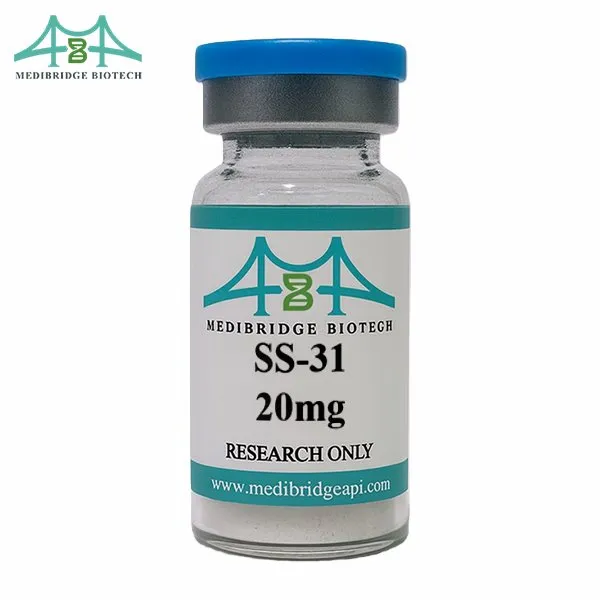


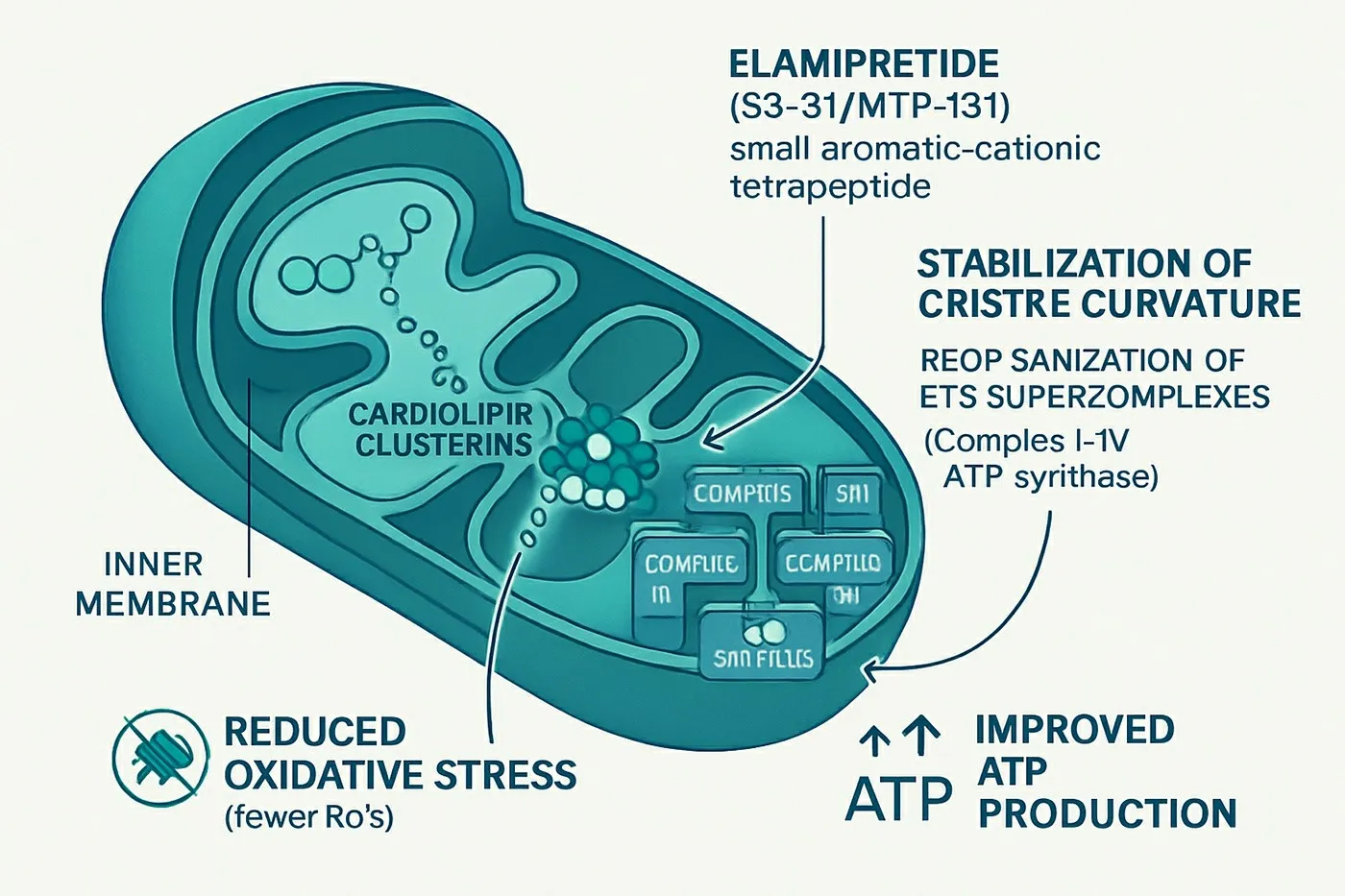
Peptide ss 31 (also known as Elamipretide, original code name MTP-131/Bendavia) is one of the most representative candidate molecules in a class of "mitochondrial-targeting tetrapeptides," evolved from the aromatic-cationic peptide (SS peptide) family proposed by the Szeto-Schiller team. With cardiolipin (CL) as its core target, it improves energy metabolism and oxidative stress by remodeling the mitochondrial inner membrane microenvironment and electron transport chain (ETC) organization. It has been extensively studied in models of multi-system ischemia-reperfusion, mitochondrial diseases, and age-related degenerative diseases, as well as in early clinical trials.
Shaanxi Medibridge Biotech Co., Ltd. is your trusted peptide partner for academia and research labs worldwide. We supply research‑use‑only peptide raw materials with rigorous quality control, responsive support, and dependable lead times. Our Elamipretide (SS‑31/MTP‑131, Bendavia) is available at ≥99.78% purity, with clear documentation and flexible batch sizes to fit your study needs.
COA
|
|
||
|
Product Name |
CAS Number |
Batch Number |
|
SS 31 |
736992-21-5 |
MB2510081437 |
|
Manufacturer Date |
Analysis Date |
Expiry Date |
|
2025-10-08 |
2025-10-09 |
2027-10-07 |
|
Sample Qty Base |
Packing |
Test Method |
|
5.85 KGS |
10Gs/BOTTLE |
HPLC |

|
Item |
Standard |
Results |
|
Purity |
≥98% |
99.78% |
|
Peptide Assay |
≥80% |
92.05% |
|
Mass Spectrum |
639.79 |
639.79 |
|
Solubility |
Soluble in water |
Complies |
|
Clarity and color of solution |
Clear and colorless |
Complies |
|
Sodium salt |
<5.0% |
1.15% |
|
Water |
≤7.0% |
3.51% |
|
Residual Solvent: |
||
|
Methanol |
≤0.3% |
Complies |
|
Isopropanol |
≤0.5% |
0.158% |
|
Acetonitrile |
≤0.041% |
0.019% |
|
Methylene Chloride |
≤0.06% |
0.028% |
|
N,N-Dimethylformamide |
≤0.088% |
Complies |
|
Triethylamine |
≤0.032% |
Complies |
|
Tert-butyl methyl ether |
≤0.5% |
0.152% |
|
Endotoxin |
≤0.5 EU/mg |
Complies |
|
Microbial Limit |
Total aerobic bacteria <100 CFU/g Total yeast & mold <50 CFU/g |
<50 CFU/g <10 CFU/g |
|
Storage |
Keep in dark and cool dry place (-20 to 8°C) |
|
|
Conclusion |
The batch conforms to the IN-HOUSE standard |
|
|
|
||

Specification(for research use only)
Our advantages
1. Boosts ETC coupling and ATP output; reduces ROS at the source.
2. Rapid, vector‑free cell uptake; strong mitochondrial enrichment in vitro/in vivo.
3. ≥99% purity (HPLC/MS), low endotoxin; lot‑specific COA and MS data.
4. Water‑soluble, lyophilized; stable at −20°C; easy, reproducible reconstitution.
5. RUO only; multiple pack sizes; consistent lots with responsive technical support.
|
Form |
Sample Order |
Specification |
|
Raw powder |
1 g |
Purity is NLT 99.78% |
|
Vials |
10 vials |
3ml/5ml/7ml/15ml vials etc. |
Mechanism of action (three-tier framework: membrane lipids, proteins, and bioenergetics)
1.Membrane‑lipid level: By binding cardiolipin (CL), SS‑31 curbs CL oxidation and imbalance, preserves proper inner‑membrane curvature and cristae organization, and thereby maintains the structural scaffold of mitochondrial energy production.
2.Protein level: It stabilizes the arrangement of electron transport chain (ETC) complexes and supercomplexes (respirasomes), reducing off‑pathway electron leak; it also restrains the peroxidase‑like shift of cytochrome c, keeping it in its electron‑carrier role and damping lipid‑peroxidation cascades.
3.Bioenergetic level: It decreases proton leak and improves coupling efficiency, raising ADP‑driven respiration and ATP generation; it lowers ROS production at the source rather than merely scavenging radicals; and it reduces the propensity for opening of the mitochondrial permeability transition pore (mPTP), thereby limiting mitochondria‑mediated apoptotic cascades.

Potential and Investigated Applications (Research Overview)
1.Mitochondria‑related disorders: Primary mitochondrial myopathies and Barth syndrome (defective cardiolipin remodeling) - an etiology‑directed arena where mechanism and disease biology align closely.
2.Cardiovascular–renal: Ischemia–reperfusion injury, heart failure, perioperative organ protection, and acute kidney injury - with emphasis on stress resilience and preservation of organ function.
3.Ophthalmology and neurodegeneration: Dry age‑related macular degeneration (AMD), optic neuropathies, and exploratory work in Parkinson's and Alzheimer's disease - leveraging bioenergetic support and membrane‑lipid homeostasis as entry points.
4.Overall research signal: Benefits are most evident under high‑stress conditions, marked mitochondrial dysfunction, or disrupted cardiolipin balance. The magnitude of effect varies by indication and endpoint (functional scales, exercise capacity, visual function, organ volumetrics/structural metrics).

Comparison with other mitochondrial targeting strategies
|
Aspect |
Peptide ss 31 (Elamipretide) |
TPP+ Carriers (MitoQ, SkQ) |
Metabolic Supplementation (CoQ10, NAD+ precursors) |
|
Targeting basis |
Cardiolipin binding; microenvironment remodeling |
Δψm driven accumulation; delivers antioxidants |
Replenishes substrates/cofactors |
|
Mechanistic focus |
Structure–organization–coupling (cristae, ETC supercomplexes) |
"Delivery" model for mitochondrial ROS scavenging |
"Supply" model for electron carriers/redox pool |
|
Δψm dependence |
Low |
High |
None |
|
ROS strategy |
Lowers production at the source |
Scavenges after formation |
Indirect redox support |
|
Complementarity |
Synergistic with metabolic supplements |
Different paradigm |
Theoretically synergistic with SS 31 |
Key Issues for Research and Translation
2.Endpoints and duration: Coupling‑oriented interventions often require longer follow‑up and endpoints that reflect physiological load (e.g., exercise capacity, organ workload, low‑luminance visual function).
3.Tissue access and dose design: Organ‑specific barriers (blood–retina, blood–brain) materially shape the exposure–response relationship; route and regimen should be tailored to the indication.
4.Mechanistic positioning: Reduction of ROS stems primarily from source control and microenvironment remodeling rather than direct radical scavenging-consistent with larger benefits in stressed/aged tissues and minimal changes in healthy tissue.

Practical tips for experimental applications (from a researcher's perspective)
1.In vitro: typical working range 10 nM–1 μM; prioritize stress, ischemia–reperfusion, or mitochondrial injury models to resolve differences.
2.In vivo: use acute dosing to capture protective effects, and chronic dosing to track gradual structure–function recovery.
3.Readouts: include mitochondrial coupling (OCR, RCR), lipid peroxidation markers, cristae ultrastructure, and electrophysiology/muscle strength/exercise capacity or organ‑specific functional measures.
4.Controls and conditions: temperature, nutritional status, oxygen tension, and calcium load strongly influence mitochondrial metrics-match controls and batches rigorously.

FAQ
Q: What is peptide SS‑31?
A: A mitochondria‑targeted tetrapeptide (elamipretide) that binds cardiolipin, stabilizes cristae/ETC coupling, boosts ATP, and lowers ROS at the source.
Q: Who discovered SS‑31?
A: From the Szeto–Schiller peptide series, developed by Hazel H. Szeto and Peter W. Schiller.
Is Shaanxi Medibridge the manufacturer of SS 31?
A: Yes, we are not only able to provide SS31 with a purity of no less than 99.78%, but Shaanxi Medibridge Biotech Co., Ltd. is also a peptide supplier.
Q: Can SS‑31 reverse aging?
A: No. It is not an anti‑aging therapy and is not approved for that purpose.
Q: What does SS‑31 do for the kidneys?
A: In renal I/R and AKI studies, it supports mitochondrial coupling and limits oxidative injury; clinical applications in kidney disease are still under evaluation.
Hot Tags: peptide ss 31, China peptide ss 31 manufacturers, suppliers, factory, Cagrilintide Powder, KPV Integrative Peptides, Selank Powder, Semaglutide Raw Powder, Sermorelin Powder, Thymosin Alpha 1 Peptide