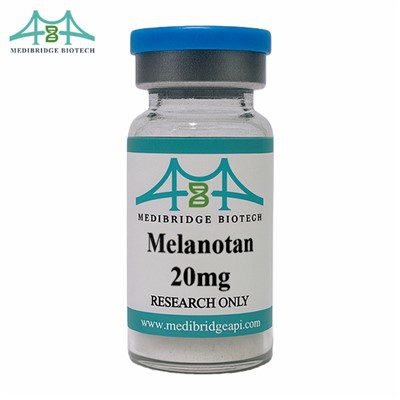
PT-141 peptide powder (generic name: bremelanotide) is a cyclic heptapeptide optimized based on the α-MSH (α-melanocyte-stimulating hormone) pharmacophore. It belongs to the melanocortin receptor (MC1R/3R/4R/5R) agonist group, with negligible MC2R (adrenergic receptor) activity. Research-grade lyophilized powder is commonly used for mechanistic studies and pharmacodynamic model construction in areas such as neuroendocrinology, sexual behavior/motivation, energy and food intake regulation, skin pigmentation, and inflammation regulation.
As one of China's top seven PT 141 producers, Shaanxi Medibridge supplies PT 141 powder at 99.85% purity. Typical laboratories reach about 99.4%. Some smaller, non‑compliant labs fall below 98%. And we can provide Higher purity. Tighter specs. Consistent results.

COA
|
|
||
|
Product Name |
CAS Number |
Batch Number |
|
PT-141 |
189691-06-3 |
MB2507190658 |
|
Manufacturer Date |
Analysis Date |
Expiry Date |
|
2025-07-19 |
2025-08-20 |
2027-07-18 |
|
Sample Qty Base |
Packing |
Test Method |
|
37.62 KGS |
100GS/ BOTTLE |
HPLC |

|
Item |
Standard |
Results |
|
Purity |
≥98% |
99.85% |
|
Peptide Assay |
≥80% |
93.54% |
|
Mass Spectrum |
1025.18 |
1025.18 |
|
Solubility |
Soluble in water |
Complies |
|
Clarity and color of solution |
Clear and colorless |
Complies |
|
Sodium salt |
<5.0% |
1.33% |
|
Water |
≤7.0% |
2.11% |
|
Residual Solvent: Methanol |
||
|
≤0.3% |
0.0072% |
|
|
Isopropanol |
≤0.5% |
N.D. |
|
Acetonitrile |
≤0.041% |
0.029% |
|
Methylene Chloride |
≤0.06% |
0.031% |
|
N,N-Dimethylformamide |
≤0.088% |
N.D. |
|
Triethylamine |
≤0.032% |
N.D. |
|
Tert-butyl methyl ether |
≤0.5% |
0.157% |
|
Endotoxin |
≤0.5 EU/mg |
Complies |
|
Microbial Limit |
Total aerobic bacteria <100 CFU/g Total yeast & mold <50 CFU/g |
<50 CFU/g <10 CFU/g |
|
Storage |
Keep in dark and cool dry place (-20 to 8°C) |
|
|
Conclusion |
The batch conforms to the IN-HOUSE standard |
|
|
|
||

Odor Profile & Fragrance Role
The odor of 2-Methyl-1-phenyl-2-propanol is soft and floral, with a light fresh tone and a mild lily-like note. There is a small amount of sweetness in the background, but it stays clean and does not feel heavy. When smelled on its own, it remains smooth rather than sharp or aggressive.
In fragrance formulas, this material is used to fill out and connect floral notes. It sits between brighter top notes and fuller body notes, which helps blends feel more even and less rough. When added to floral bases, it can give a little more body without changing the overall direction of the scent.
Because the odor stays stable and predictable, it fits easily into many fragrance types, including fine fragrance, personal care, and household products. It mixes well with other aroma chemicals and common floral materials.

Specifications (for research use only)
Our advantages
1. Double LC-MS confirmation, with original chromatograms/mass spectra provided for every batch.
2. Low endotoxin content (<0.1 EU/mg), ensuring greater peace of mind in cell and animal experiments.
3. Expert-level technical support, rapid response to experimental design and usage instructions.
|
Form |
Sample Order |
Specification |
|
Raw powder |
1 g |
Purity is NLT 99.96% |
|
Vials |
10 vials |
3ml/5ml/7ml/15ml vials etc. |
Mechanism & Targets
PT-141 is a melanocortin receptor agonist primarily acting on the central MC4R, with additional MC1R activity; its core signaling pathway is Gs-AC-cAMP-PKA, accompanied by activation of downstream pathways such as ERK.
It regulates motivation, feeding, and energy balance by influencing hypothalamic-limbic system circuits (such as PVN, MPOA, NAc/VTA); and mediates pigmentation through MC1R in the skin/hair follicles.
Unlike PDE5's "peripheral blood flow mechanism," PT-141 leans towards a "central motivation mechanism"; due to its Trp content, it is easily oxidized, requiring careful attention to antioxidant protection and light avoidance during formulation and experimental testing.

Receptor Profile and Functional Associations
Selectivity: Highly potent for MC4R and MC1R, followed by MC3R/MC5R; nearly inactive for MC2R. Different species/expression systems may lead to phenotypic differences; cross-sectional comparisons within the same plateau are recommended.
Physiological Location and Functions
a.MC4R: Hypothalamic arcuate nucleus/paraventricular nucleus (PVN), etc., primarily involved in motivation, feeding inhibition, and energy homeostasis.
b.MC1R: Melanocytes/hair follicles, mediating melanin synthesis and pigment phenotype.
c.MC3R/MC5R: Particularly involved in energy metabolism and glandular secretion; often used for auxiliary verification in studies.
Signal Transduction
a.Mainly: Gs upregulates cAMP → PKA/CREB; common readouts include cAMP accumulation, CRE-reporter activity, and ERK phosphorylation.
b.Receptor Kinetics: Sustained high concentrations can lead to β-arrestin-mediated endocytosis and desensitization, manifesting as an effector plateau or rightward shift; experimental control of exposure duration and dose is necessary.
Key Points of Pharmacology (Research Perspective)
Pigment Biology
a. In vitro: Increases melanin content, tyrosinase activity, and MITF/TYR/TYRP1 expression in MC1R-positive melanocytes; often synergistically amplifies dynamic range with UV/inflammation.
b. In vivo: Rodent coat color/skin Lab* changes can be quantified into phenotypic readouts; skin barrier, metabolism, and species differences must be considered.
Compared to Melanotan II, the pigmentary effect of PT-141 peptide powder is generally milder but still visible; experiments require positive and negative controls and time series analysis.

Feeding and Metabolism
a. Acute appetite suppression is significant, accompanied by short-term upregulation of energy expenditure (indirect calorimetry can detect changes in VO2/VCO2); chronic administration is prone to effect decay or behavioral compensation.
b. Genes/Proteins: The trend of upregulation of hypothalamic POMC and downregulation of AgRP/NPY can be reproduced in some models, but heterogeneity is high, requiring verification with c-Fos or single-cell transcription.
Metabolic tolerance is influenced by species, sex, and nutritional status; it is recommended to confirm the purely pharmacodynamic contribution under paired feeding or crossover designs.

Inflammation and Pain (Tool Applications)
a. The α-MSH pathway has a literature basis for anti-inflammatory/analgesic effects; PT-141 can be used to explore the regulation of NF-κB/COX-2, inflammatory factors (TNF-α, IL-6), and peripheral immune-neural axis linkages.
b. It is recommended to use receptor antagonists (such as SHU9119/HS014) and CRISPR/siRNA targets for validation to avoid misattribution of "effect-like" factors.
PK/PD
Distribution and Barriers
a. Primarily metabolized by peptidase; blood-brain barrier permeability is limited; effective central effects usually result from higher peripheral exposure or direct central delivery.b. Tissue binding and plastic adsorption can lead to higher apparent clearance; actual effective exposure needs to be calibrated using bioanalysis or functional readout.

Half-life and Tolerance
a. Small molecule cyclic peptides generally have a half-life in vivo on the order of hours; repeated administration may lead to receptor desensitization and behavioral tolerance; it is recommended to set washout periods and intermittent dosing.b. Adverse reactions associated with species susceptible to emetic reflexes (ferrets, dogs) can serve as a warning of safety limits; in rodents, adverse reactions often manifest as transient decreased activity/gastrointestinal discomfort.

FAQ
Q: What is PT-141? What are its target and mechanism of action?
A: PT-141 (bremelanotide) is a cyclic heptapeptide melanocortin receptor agonist, primarily acting via MC4R. It mainly follows the Gs→AC→cAMP→PKA→CREB pathway, exhibiting a central motivational mechanism; it is independent of the NO–cGMP (PDE5) pathway.
Q: What are its typical research applications?
A: It is a tool compound for research in areas such as sexual motivation/reward pathways, feeding and energy homeostasis, and melanin production mechanisms. It is for research use only and should not be used for diagnosis or treatment.
Q: To what extent can you guarantee quality?
A: We can guarantee a main peak purity of ≥99% via reversed-phase HPLC/UPLC; molecular weight confirmation via LC-MS.
Q: Are you a manufacturer? Can you control impurities and residues?
A: Of course, we are a GMP-compliant peptide manufacturer. Simultaneous monitoring of ring-opening/cyclization, deamidation, Trp oxidation, etc.; reporting of ions (TFA/acetic acid) and moisture (KF); residual solvent (GC) and heavy metal (ICP-MS) analysis available upon request.
Q: Do you have endotoxin control?
A: Yes, we can provide low endotoxin batches (e.g., <0.5 EU/mg) to match sensitive systems.
Q: What are the salt forms and sequences we purchase?
A: The salt form is generally Na salt; the sequence is Ac-Nle-c[Asp-His-D-Phe-Arg-Trp-Lys]-NH2.
Q: Which experiments are suitable? What controls and readout recommendations are available?
A: a. In vitro: cAMP (HTRF/Glo), CRE-Luc, ERK phosphorylation, and β-arrestin in stable MC4R/MC1R strains; α-MSH/Melanotan II was used as a positive control, and SHU9119/HS014 antagonism was used to verify specificity.
b. Pigmentation model: melanin content in melanocytes, tyrosinase activity, and MITF/TYR/TYRP1 expression; in vivo, Lab* colorimetric time-series measurements can be performed.
Hot Tags: pt 141 peptide powder, China pt 141 peptide powder manufacturers, suppliers, factory, ARA 290 Powder, Ipamorelin Powder, Peptide Adipotide, Peptide SS 31, Semaglutide Raw Powder, Tirzepatide for Weight Loss