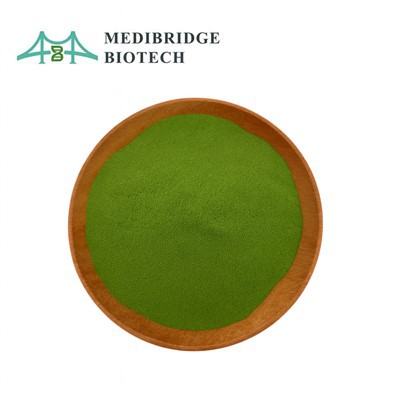
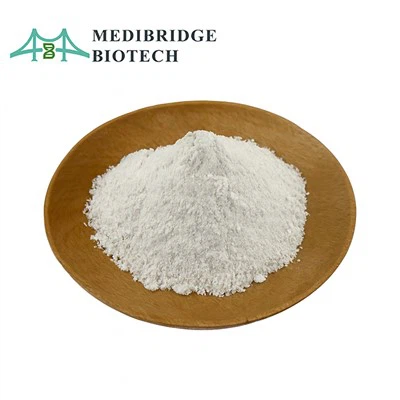
Amygdalin is a naturally occurring cyanogenic glycoside mainly found in the seeds of Rosaceae plants such as bitter almond, apricot kernel, and peach seed. In commercial production, it is usually obtained through controlled extraction, followed by purification and crystallization steps to reach a defined purity level. Some supply routes may also use semi-synthetic adjustment or further refinement to improve batch consistency for laboratory and technical use.
This compound is mostly discussed in research settings because of its enzyme-responsive behavior and clear molecular structure. It is commonly used as a reference material in studies involving glycosidic hydrolysis, enzyme-triggered transformation, and substrate behavior under controlled experimental conditions. For this type of product, it is better to keep the focus on molecular behavior, handling logic, and research value rather than push it toward broad function claims.
Shaanxi Medibridge Biotech Co., Ltd. supplies high-purity plant-derived compounds and research-oriented raw materials with stable specifications, practical documentation support, and flexible service for laboratory and formulation customers.
COA
|
|
||
|
Product Name |
CAS Number |
Batch Number |
|
Amygdalin Powder |
29883-15-6 |
MB2601241030 |
|
Manufacturer Date |
Analysis Date |
Expiry Date |
|
2026-01-24 |
2026-01-25 |
2028-01-23 |
|
Sample Qty Base |
Packing |
Test Method |
|
500KGS |
25kg/drum |
HPLC |

|
Item |
Standard |
Results |
|
Appearance |
White to off-white crystalline powder |
Conforms |
|
Identification (HPLC) |
Retention time consistent with reference standard |
Conforms |
|
Molecular Formula |
C20H27NO11 |
Conforms |
|
Molecular Weight |
457.43 |
Conforms |
|
Purity (HPLC) |
NLT 98.0% |
98.42% |
|
Solubility |
Soluble in water |
Conforms |
|
Loss on Drying |
NMT 2.0% |
0.86% |
|
Residue on Ignition |
NMT 0.5% |
0.18% |
|
Heavy Metals |
NMT 10 ppm |
Conforms |
|
Arsenic (As) |
NMT 2 ppm |
Conforms |
|
Microbial Limits |
Complies with laboratory reagent standards |
Conforms |
|
Storage |
Store in cool & dry place. keep away from strong light and heat |
|
|
Conclusion |
The batch conforms to the IN-HOUSE standard |
|
|
|
||

Enzyme-Responsive Behavior
One important feature of this ingredient is that it does not behave the same way in every environment. Under stable conditions, the structure can remain relatively intact, but in the presence of specific enzymes such as β-glucosidase, the glycosidic bonds can be hydrolyzed step by step. This is why it is often discussed as an enzyme-responsive compound rather than a simple stable small molecule.
During this process, downstream products such as benzaldehyde and hydrogen cyanide may be formed. Because of that, the value of this material in research usually lies in studying controlled transformation, substrate–enzyme interaction, and conditional release behavior under defined test conditions.

Natural Source & Molecular Profile
This compound is associated with several seed materials from the Rosaceae family, especially bitter almond and apricot kernel. From a raw-material point of view, what makes it useful is not just that it comes from a natural source, but that its molecular identity is clear and its behavior is relatively easy to track in controlled systems.
After purification, the material can be supplied as a high-purity crystalline powder with good reproducibility for analytical, biochemical, and formulation-related work. That makes it more suitable as a defined research compound than as a vague botanical concept ingredient.

Typical Application Areas
This ingredient is mainly used in laboratory and research-oriented settings. Common directions include enzyme activity studies, glycoside hydrolysis research, controlled transformation models, and natural-product-related analytical work.
In formulation-related research, it may also be used in experimental systems where conditional activation, release behavior, or compound stability needs to be observed under controlled conditions. For this type of material, the page should stay clearly on the research and technical side instead of moving into direct-use consumer language.

Formulation & Specification Notes
This material is generally handled in purified water or appropriate buffer systems when solution preparation is needed. Because its behavior can change in the presence of enzymes, pH conditions, temperature, and the composition of the surrounding system should all be checked in advance during method design or formulation testing.
For storage and handling during testing, it is better to keep conditions controlled and avoid unnecessary exposure to heat, moisture, and catalytic environments that may trigger unwanted decomposition. When a project involves enzyme-containing systems, compatibility and activation risk should be evaluated before use.

Safety Profile
This is not a casual-use ingredient. Because it can generate hydrogen cyanide after enzymatic hydrolysis, handling should follow strict laboratory safety practice, and the material is better positioned for research and controlled technical work only. Public health and cancer sources also warn that amygdalin/laetrile exposure is associated with cyanide toxicity risk, and it is not approved as an effective anticancer treatment in the United States.
Protective equipment, controlled working conditions, and clear internal handling rules are all important. It should not be written or positioned like a normal nutritional ingredient or direct-consumption raw material.

Use / Storage Considerations
Store it in a cool, dry, and light-protected place, with the container tightly sealed. Moisture, heat, and unnecessary exposure to reactive environments should be avoided during routine storage and sample handling.
For technical use, it is better to separate routine storage from active test environments, especially when enzyme-containing materials are present. Clear labeling and restricted-access handling are more suitable for this type of compound than general warehouse-style wording.

FAQ
Q: Is this the same as Vitamin B17?
A: It is often referred to as "Vitamin B17," but it is not officially recognized as a vitamin.
Q: Can it be used for direct consumption?
A: No, this material is better limited to research and controlled technical use because of the risk of hydrogen cyanide release.
Q: Why is it often used in enzyme studies?
A: Because its structure can be hydrolyzed under specific enzymatic conditions, which makes it useful for studying controlled transformation behavior.
Q: How should it be stored?
A: Keep it sealed in a cool, dry, and light-protected environment and avoid unnecessary exposure to reactive conditions.
Q: What kind of projects is it suitable for?
A: It is mainly suitable for enzyme-related studies, analytical research, and controlled formulation or transformation experiments.
Hot Tags: amygdalin powder, China amygdalin powder manufacturers, suppliers, factory, D Theanine Powder, plant extracts, Best Berberine Powder, Rhodiola Rosea Extract Powder, Hesperidinase, Licorice Extract Powder