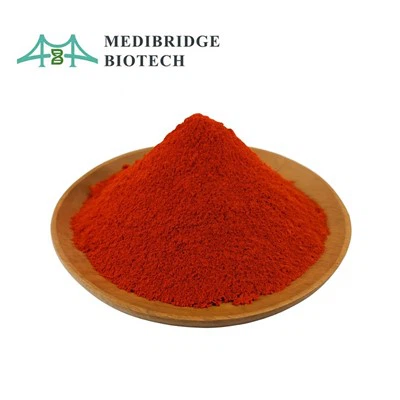
Haematococcus pluvialis extract powder is a natural substance derived from freshwater microalgae called haematococcus pluvialis. Rainy red algae extract powder contains a high concentration of potent astaxanthin, responsible for the algae's vibrant red color. Astaxanthin has gained attention for its potential health benefits, particularly anti-inflammatory properties, cardiovascular support, and immune system enhancement.As an antioxidant, astaxanthin is believed to help protect cells from oxidative damage caused by free radicals, which are byproducts of normal bodily processes as well as environmental factors such as pollution and UV radiation. By suppressing these free radicals, astaxanthin may reduce inflammation and enhance overall cellular health.
Shaanxi Medibridge Biotech Co., Ltd. supplies plant extracts, nutritional ingredients, and custom specification products for different sourcing and formulation needs. We support stable supply, routine specification matching, and flexible packaging service for ingredient-based product development.
COA
|
|
||
|
Product Name |
CAS Number |
Batch Number |
|
Haematococcus Pluvialis Extract Powder |
472-61-7 |
MB2604150549 |
|
Manufacturer Date |
Analysis Date |
Expiry Date |
|
2026/4/15 |
2026/4/16 |
2028/4/15 |
|
Sample Qty Base |
Packing |
Test Method |
|
150KGS |
25KG/drum |
HPLC |
|
|
||
|
Item |
Standard |
Results |
|
Appearance |
Fine Red Powder |
Conform |
|
Odor |
Characteristic |
Conform |
|
Assay |
≥5% Astaxanthin |
5.72% |
|
Particle Size |
98% pass 80mesh |
Conform |
|
Moisture |
<5.0% |
Conform |
|
Ash Content |
<4.0% |
Conform |
|
Solvent Residue |
Eur.Pharm |
Conform |
|
Total Heavy Metals |
<10 ppm |
Conform |
|
Arsenic |
<1.0 ppm |
Conform |
|
Lead |
<1.0 ppm |
Conform |
|
Mercury |
<0.5 ppm |
Conform |
|
DDT |
<0.2ppm |
Conform |
|
E. Coli |
Negative |
Negative |
|
GMO Status |
Complies |
GMO Free |
|
Irradiation |
Complies |
Irradiation Free |
|
Conclusion |
The batch conforms to the IN-HOUSE standard |
|
|
|
||


Biological Basis & Extraction Characteristics
Haematococcus pluvialis is a unicellular freshwater green alga. Its unique feature lies in its two distinct growth morphology stages:
Motile Growth Phase (Green Phase):
Under nutrient-rich and favorable environmental conditions, algal cells undergo asexual reproduction, primarily accumulating chlorophyll and proteins within the cells.
Aplanospore Phase (Red Phase):
When subjected to environmental stress-such as high light intensity, strong ultraviolet radiation, nutrient starvation, or high salinity-the cells form thick-walled encysted spores (aplanospores). During this phase, they synthesize and accumulate large amounts of natural astaxanthin (up to 1.5%–5% of cell dry weight) to withstand environmental stress.

Core Active Ingredients & Structural Advantages

Although the extract contains small amounts of microalgal proteins, polyunsaturated fatty acids (PUFAs), and polysaccharides, its core pharmacological activity originates primarily from natural astaxanthin (ASTA).
Transmembrane Molecular Structure:
Astaxanthin possesses polar hydrophilic rings at both ends connected by a central lipophilic long chain with conjugated double bonds. This structure allows it to span vertically across the cell membrane's phospholipid bilayer, simultaneously scavenging free radicals on both the interior and exterior of the cell membrane to maintain cellular integrity.
Potent Antioxidant Capacity:
Clinical and in vitro studies demonstrate that its capacity to quench singlet oxygen and scavenge free radicals far exceeds that of traditional antioxidants (approximately 6,000 times that of Vitamin C, 800 times that of Coenzyme Q10, and 500 times that of Vitamin E).
Natural Esterified Form:
Unlike synthetic astaxanthin or astaxanthin derived from Phaffia rhodozyma (red yeast), over 90% of astaxanthin in Haematococcus pluvialis exists in esterified forms (monoesters and diesters). This esterified form offers superior stability and higher intestinal absorption efficiency in humans.
Core Efficacy & Mechanisms of Action
Photoaging Protection & Skin Health
Mechanism: Inhibits the expression of matrix metalloproteinases (MMP-1, MMP-3) induced by ultraviolet (UV) radiation, blocking the degradation of collagen and elastic fibers.
Application: Reduces wrinkle formation, improves skin elasticity, and suppresses melanin deposition (reducing UV-induced pigmentation).


Cross-Barrier Protection (Retinal & Central Nervous System)
Mechanism: Astaxanthin can cross both the blood-brain barrier (BBB) and the blood-retinal barrier (BRB).
Application: Used in ophthalmology to relieve visual fatigue and prevent age-related macular degeneration (AMD); used in neuroscience to reduce oxidative damage and chronic inflammation in nerve cells, assisting in the prevention of neurodegenerative diseases.
Anti-Inflammation & Cardiovascular Protection
Mechanism: Downregulates the NF-κB signaling pathway, reducing the release of inflammatory cytokines such as tumor necrosis factor-alpha (TNF-α), interleukin-6 (IL-6), and C-reactive protein (CRP).
Application: Inhibits the oxidation of low-density lipoprotein (LDL), improves vascular endothelial function, and delays the progression of atherosclerosis.


Muscle Endurance & Anti-Exercise Fatigue
Mechanism: Protects mitochondrial membranes from oxidative damage, enhances mitochondrial energy metabolism (ATP production), reduces lactic acid accumulation, and promotes fatty acid oxidation for energy supply.
Industrial Application Status
|
Application Sector |
Common Forms / Labeled Content |
Primary Functions |
|
Nutraceuticals & Dietary Supplements |
5%–10% Astaxanthin powder, softgels |
Anti-aging, eye protection, anti-fatigue, cardiovascular health |
|
Cosmetics & Skincare |
Refined oil-soluble / water-dispersible extracts |
Premium antioxidant, sun protection & repair, anti-photoaging |
|
Functional Foods & Medical Foods |
Cell-disrupted algal powder / microencapsulated powder |
Beverages, tablet candies, functional food fortification |
|
Aquaculture & Animal Feed |
0.5%–2% Unrefined crude extract |
Enhancing immunity in aquatic/livestock animals, pigmentation |
FAQ
What is Haematococcus pluvialis good for?
Haematococcus pluvialis is a fresh-water green microalga best known as the richest natural source of astaxanthin, a powerful antioxidant.
What is Haematococcus pluvialis?
Haematococcus pluvialis is a single-celled freshwater green microalga best known as the world's richest natural source of astaxanthin, a powerful antioxidant.
Is Haematococcus pluvialis a good source of astaxanthin?
Haematococcus pluvialis is widely considered the richest and best natural source of astaxanthin on Earth.
What happens to your body when you take astaxanthin?
When you take astaxanthin, this reddish pigment acts as a strong antioxidant that protects your cells from damage, lowers swelling, and supports your skin, eyes, and heart.
If you are looking for a high-quality Haematococcus Pluvialis Extract Powder manufacturer with whom you can establish a long-term, stable partnership, then Shaanxi Medibridge Biotech Co., Ltd. would be your best business partner. Don't hesitate to contact us at hi@medibridgeapi.com.
Hot Tags: haematococcus pluvialis extract powder, China haematococcus pluvialis extract powder manufacturers, suppliers, factory, Centella Asiatica Leaf Extract, epicatechin drug formulation ingredient, Ginsenoside CK, hericium erinaceus fine powder extract, hesperidinase enzyme blend ingredient, hesperidinase high purity enzyme