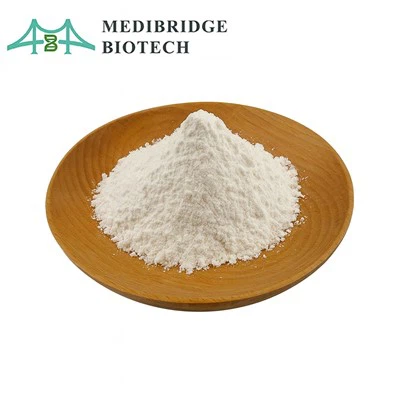
Beta-NMN, also known as β-nicotinamide mononucleotide (NMN), serves as a substrate for the synthesis of coenzyme I (NAD+) and is utilized in anti-aging research. Studies indicate that β-NMN regulates insulin secretion and influences mRNA expression levels, suggesting broad prospects for its application in medical therapy. β-Nicotinamide mononucleotide is a product of the extracellular nicotinamide phosphoribosyltransferase (eNAMPT) reaction and a key NAD+ intermediate. It improves glucose tolerance by restoring NAD+ levels in mice with high-fat diet (HFD)-induced type 2 diabetes (T2D). Additionally, it enhances hepatic insulin sensitivity and-partly through SIRT1 activation-restores the expression of genes associated with oxidative stress, inflammatory responses, and circadian rhythms.
Shaanxi Medibridge Biotech Co., Ltd. focuses on the supply of pharmaceutical raw materials and research-use compounds. We support customers with stable quality, clear specification communication, flexible packaging options, and document-related support for different project stages.
COA
|
|
||
|
Product Name |
CAS Number |
Batch Number |
|
Beta-NMN |
1094-61-7 |
MB2606131242 |
|
Manufacturer Date |
Analysis Date |
Expiry Date |
|
2026/6/13 |
2026/6/15 |
2028/6/15 |
|
Sample Qty Base |
Packing |
Test Method |
|
100KGS |
25KG/drum |
HPLC |
|
|
||
|
Item |
Standard |
Results |
|
Appearance |
White to off-white powder |
Conforms |
|
Purity (HPLC) |
≥99.0% |
99.5% |
|
pH |
2.0-4.0 |
3.2 |
|
Water content |
≤5.0% |
0.41% |
|
Identification |
Conform to the RT of Standard |
Conforms |
|
Heavy Metal |
||
|
As |
≤0.5ppm |
N.D |
|
Pb |
≤0.5ppm |
N.D |
|
Cd |
≤0.5ppm |
0.010ppm |
|
Hg |
≤0.5ppm |
N.D |
|
Microbial Limit |
||
|
Total microbial count |
≤750CFU/g |
80CFU/g |
|
Coliform |
≤3.0MPN/g |
N.D |
|
Ethanol (By GC) |
≤5000ppm |
223ppm |
|
Conclusion |
The batch conforms to the IN-HOUSE standard |
|
|
|
||


Metabolic Pathways
In the salvage pathway, β-nicotinamide mononucleotide (NMN) is synthesized from NAM and PRPP by NAMPT-the rate-limiting enzyme for mammalian NAD+ biosynthesis-or from NR via NRK-mediated phosphorylation; NMN is subsequently converted into NAD+ by NMNATs. In mammals, there are three NMNAT isoforms encoded by distinct genes-NMNAT1, NMNAT2, and NMNAT3-localized in the nucleus, Golgi apparatus, and mitochondria, respectively. Enzymes that consume NAD+ within the salvage pathway (such as PARPs, Sirtuins, CD38/T10, CD157/BST1, and SARM1) degrade NAD+ while performing their enzymatic functions, generating NAM as a byproduct; NAM is then methylated by NNMT to form MeNAM, which is further broken down into Me2PY and Me4PY for excretion. NAMPT is the rate-limiting enzyme of the salvage pathway; total NAMPT deficiency in mice results in embryonic lethality. Furthermore, tissue-specific deletion of NAMPT in mouse tissues-including skeletal muscle, liver, and adipose tissue-reduces NAD+ levels in the respective organs.
In addition to the primary salvage pathway, NAPRT catalyzes a step in the Preiss-Handler pathway, converting NA into NAMN; meanwhile, the *de novo* pathway converts Trp into QA, which is then transformed into NAMN via QPRT catalysis, marking the convergence of these two pathways. Following a series of reactions that convert the intermediates into NAAD, the process culminates in the formation of NAD+ via the action of NADS.

Cellular Uptake of Beta-NMN

Regarding the uptake and utilization of β-nicotinamide mononucleotide (β-NMN), studies using stable isotope-labeled NMN have revealed that NMN is dephosphorylated extracellularly into nicotinamide riboside (NR); research employing various chemical inhibitors indicates that NR enters cells via equilibrative nucleoside transporters (ENTs). However, NR is unstable and rapidly degrades into nicotinamide (NAM) in mouse plasma or culture media containing fetal bovine serum. This suggests that after oral administration and entry into the bloodstream, β-NMN can be extracellularly converted into NR and subsequently transported into cells, although a portion is converted into NAM-either through hepatic metabolism or hydrolysis within the circulation-following its conversion to NR.
Comparison of Raw Material Synthesis Routes
Three primary technical routes are currently used in the industrial manufacturing of Beta-NMN:
|
Route |
Technical Features |
Advantages |
Disadvantages / Limitations |
|
Enzymatic Synthesis |
Mimics endogenous synthesis pathways using NRK or NAMPT enzymes |
High specificity (pure β-isomer), zero harmful organic solvent residue, low heavy metals, superior quality |
High production cost; complex enzyme immobilization technology |
|
Chemical Synthesis |
Multi-step organic chemical condensation |
Suitable for large-scale mass production; readily available starting materials |
Prone to isomeric impurities (α-NMN), organic solvent residues, and by-products |
|
Fermentation |
Biosynthesis using engineered strains |
Environmentally friendly and natural |
Low yield; extremely tedious extraction/purification; high cost |
Physiological Functions & Research Directions

Based on recent preclinical and clinical studies, research applications for Beta-NMN focus on the following key domains:
Anti-Aging & Mitochondrial Protection
Mitochondrial Biogenesis: Elevates the NAD+/NADH ratio, restoring mitochondrial respiratory chain activity and ATP production in senescent cells.
Physical Function Enhancement: Clinical trials demonstrate that Beta-NMN supplementation improves muscle strength, walking speed, and endurance in middle-aged and older adults.
Metabolic Health & Insulin Sensitivity
Glucose & Lipid Metabolism: Studies show Beta-NMN significantly alleviates insulin resistance induced by high-fat diets or aging, boosting glucose utilization in the liver and skeletal muscle.
Weight Management: Promotes fatty acid β-oxidation, assisting in energy expenditure balance.


Cardiovascular & Neuroprotective Effects
Endothelial Function Restoration: Activates SIRT1 to promote endothelial nitric oxide synthase (eNOS) expression, improving vascular elasticity and microcirculation.
Neurodegenerative Research: Increases brain NAD+ levels, reducing neuroinflammation, amyloid-beta (Aβ) deposition, and neuronal apoptosis in Alzheimer's disease models.
DNA Repair & Stress Resistance
Enhances cellular self-repair capabilities against ultraviolet (UV) radiation, ionizing radiation, or chemical toxins, maintaining genomic stability.

FAQ
What is NMN beta good for?
β-NMN is primarily researched and used as a precursor to boost levels of NAD+, an essential coenzyme involved in cellular energy production, metabolism, and DNA repair.
What happens when you take NMN every day?
Taking NMN every day quickly raises blood levels of the anti-aging coenzyme NAD+ by roughly 40%.
What is the risk of taking NMN?
Taking NMN is mostly safe in short tests, but long-term risks are still unknown.
Which form of NMN is the most effective?
Oral NMN capsules with enteric coating or standard pharmaceutical-grade powder.
If you are looking for a high-quality Beta-NMN manufacturer with whom you can establish a long-term, stable partnership, then Shaanxi Medibridge Biotech Co., Ltd. would be your best business partner. Don't hesitate to contact us at hi@medibridgeapi.com.
Hot Tags: beta-nmn, China beta-nmn manufacturers, suppliers, factory