





Osimertinib Mesylate Powder also known as azd9291 mesylate powder, is the hydrochloride form of Osimertinib, an orally active, specific, irreversible epidermal growth factor receptor (EGFR) Tyrosine kinase inhibitor. It is a type of drug called a tyrosine kinase inhibitor (TKI). Specifically, it is an epidermal growth factor receptor (EGFR) tyrosine kinase inhibitor. Enzymes called tyrosine kinases are essential for cell signaling; blocking these enzymes could be a focused treatment strategy for some pathological cellular illnesses. Osimertinib treats non-small cell lung disease with specific mutations in the EGFR gene. These mutations, known as the EGFR-T790M mutations, are associated with resistance to other EGFR inhibitors. By inhibiting the activity of mutated EGFR, Osimertinib helps slow or stop the growth of diseased cells. It is mainly used to treat individuals with chronic myelogenous leukemia daily, particularly if the disease advances to the acute or regular phase. It may also play a role in the treatment of other blood disorders.
Shaanxi Medibridge Biotech Co., Ltd. focuses on the supply of pharmaceutical raw materials and research-use compounds. We support customers with stable quality, clear specification communication, flexible packaging options, and document-related support for different project stages.
COA
|
|
||
|
Product Name |
CAS Number |
Batch Number |
|
Osimertinib Mesylate Powder |
1421373-66-1 |
MB2608082541 |
|
Manufacturer Date |
Analysis Date |
Expiry Date |
|
2026/8/08 |
2026/8/09 |
2028/8/08 |
|
Sample Qty Base |
Packing |
Test Method |
|
650GS |
10GS/bottle |
HPLC |
|
|
||
|
Item |
Standard |
Results |
|
Appearance |
White to off white powder |
Conforms |
|
Identification |
By IR |
Conforms |
|
Solubility |
Soluble in dimethylsufoxide, slightly soluble in ethanol and acetonitrile, with Ph dependent aqueous solubility |
Conforms |
|
Water content(KF) |
≤1.00% |
0.38% |
|
Rsidue on ignition |
≤0.10% |
0.05% |
|
Heavy metals |
≤20.00ppm |
Conforms |
|
Solvent residue |
Acetonitrile≤410ppm |
Not detected |
|
Related substances |
Maximum single impurity: ≤0.20% |
0.05% |
|
Assay (HPLC basis on drying) |
98.00%~102.00% |
99.81% |
|
Conclusion |
The batch conforms to the IN-HOUSE standard |
|
|
|
||


Powder Solid State, Particle Size and Batch Variability
The European Medicines Agency (EMA) described the osimertinib mesylate material it evaluated as an achiral, non-hygroscopic crystalline solid. Its assessment included water content, particle size distribution, and polymorphic form among the quality or stability attributes examined. For batch comparisons, X-ray powder diffraction (XRPD) can identify differences in crystalline form, differential scanning calorimetry and thermogravimetric analysis (DSC/TGA) can characterize thermal events and associated mass loss, and Karl Fischer titration can quantify water content.

pH-Dependent Solubility and Experimental Exposure
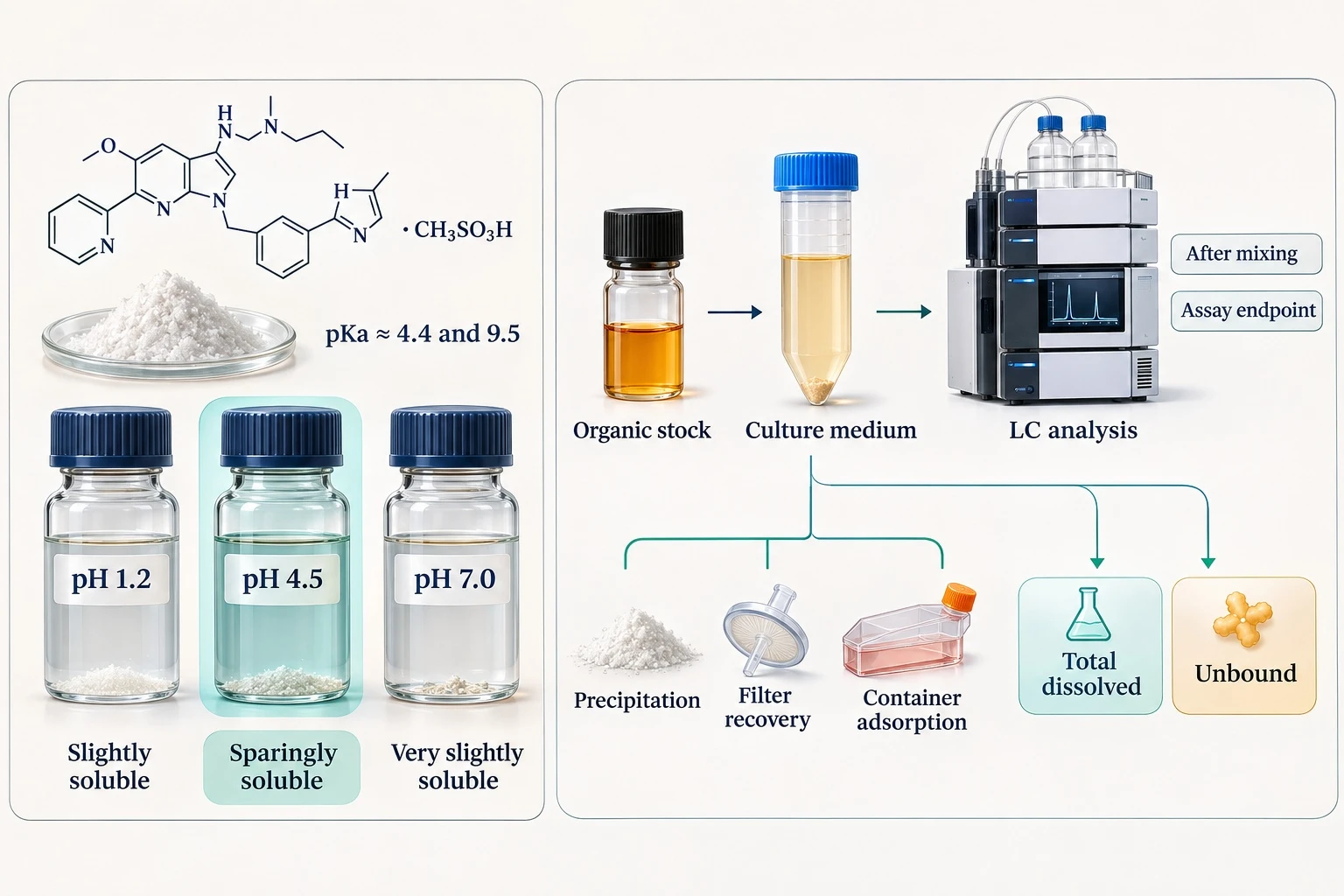
Reported pKa values are approximately 4.4 for the aniline-type site and 9.5 for the aliphatic amine. The EMA assessment reported higher aqueous solubility in pH 4.5 buffer than under the conditions tested at pH 1.2 or pH 7. A solubility study should record buffer composition, temperature, equilibration time, and final pH. If undissolved material remains at equilibrium, characterizing that solid helps interpret the measured concentration.
When an organic stock solution is diluted into culture medium, the dissolved concentration can differ from the nominal concentration. LC measurements of the clarified medium immediately after preparation and at the assay endpoint can track parent-compound recovery. Precipitation, filter recovery, and container adsorption controls help explain losses. In serum-containing media, total dissolved concentration and unbound concentration are distinct measures of exposure.
Covalent Binding to Cys797 and Inhibition Kinetics
Osimertinib first forms a noncovalent complex with the EGFR kinase domain. The sulfur of Cys797 can then react with the acrylamide group to form a covalent adduct. Measuring inhibition over several preincubation times can reveal time-dependent inhibition. Intact-protein mass spectrometry can detect the mass shift associated with adduct formation, and peptide LC–MS/MS can localize the modified residue.

EGFR Mutant Selectivity and Quantitative Evidence
T790M is a substitution at the gatekeeper position of the EGFR ATP-binding pocket. Yun and colleagues found that introducing T790M into an L858R background increased the kinase's affinity for ATP by more than an order of magnitude. In the tested cellular models, osimertinib inhibited EGFR phosphorylation at lower concentrations in mutant EGFR models than in wild-type models.
|
Cell model |
EGFR background |
Apparent IC50 for inhibition of EGFR phosphorylation |
|
PC-9 VanR |
Exon 19 deletion / T790M |
Approximately 6 nM |
|
H1975 |
L858R / T790M |
Approximately 15 nM |
|
PC-9 |
Exon 19 deletion |
Approximately 17 nM |
|
Wild-type models tested |
Wild-type EGFR |
Approximately 480–1,800 nM |
C797S and Structure–Function Analysis
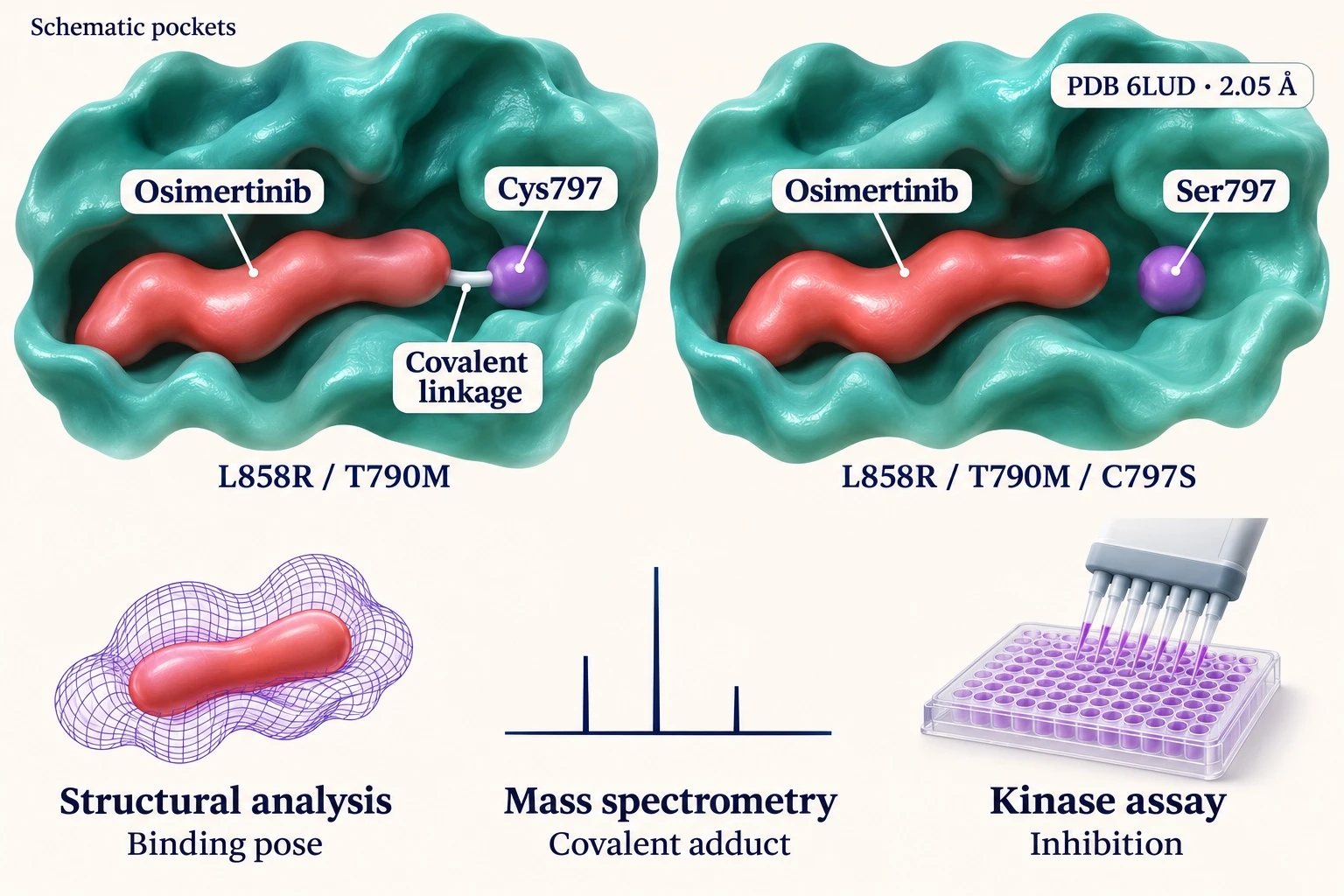
The C797S substitution replaces cysteine with serine, removing the sulfur required for the original covalent linkage. Thress and colleagues found that C797S substantially reduced cellular sensitivity to osimertinib in the EGFR mutant background they studied. The 2.05 Å crystal structure deposited as PDB 6LUD shows how osimertinib can bind to the L858R/T790M/C797S kinase domain.
Comparing otherwise matched EGFR constructs with and without C797S can help identify which step is affected. Structural analysis shows the binding pose, mass spectrometry detects covalent adduct formation, and kinase assays quantify the resulting inhibition.
From Target Engagement to Cellular Phenotype
A cellular time course can follow EGFR target occupancy or covalent adduct formation, phosphorylated EGFR (p-EGFR), downstream p-ERK and p-AKT, and later changes in proliferation or viability. Early measurements capture receptor and pathway responses. Later measurements show whether signaling recovers and whether the cellular phenotype changes. Measuring total EGFR, ERK, and AKT alongside their phosphorylated forms helps distinguish changes in protein abundance from changes in the proportion phosphorylated.
If p-EGFR remains suppressed while p-ERK recovers, downstream feedback and signaling from other receptors are possible explanations to test.

Metabolites and Protein Adducts

In vitro studies identified CYP3A as the predominant enzyme family involved in osimertinib metabolism. AZ5104 and AZ7550 are two demethylated metabolites relevant to mechanistic studies. Radiolabeled incubation studies also detected covalent binding in hepatocyte, plasma, and human serum albumin systems.
In plasma or hepatocyte experiments, measuring the parent compound, individual metabolites, and protein-associated material at matched time points can help explain a decline in parent concentration.
FAQ
What is osimertinib mesylate?
Osimertinib mesylate is a prescription medication used to treat adults with certain types of non-small cell lung cancer (NSCLC).
Is osimertinib a chemotherapy?
No, osimertinib (commonly known by its brand name, Tagrisso) is not a traditional chemotherapy.
What is osimertinib used for?
Osimertinib is a third-generation, oral targeted cancer medication used to treat specific types of non-small cell lung cancer (NSCLC).
Is osimertinib taken orally?
Yes, osimertinib is taken orally as a tablet once daily.
If you are looking for a high-quality Osimertinib Mesylate Powder manufacturer with whom you can establish a long-term, stable partnership, then Shaanxi Medibridge Biotech Co., Ltd. would be your best business partner. Don't hesitate to contact us at hi@medibridgeapi.com.
Hot Tags: osimertinib mesylate powder, China osimertinib mesylate powder manufacturers, suppliers, factory, dicyclanil animal health ingredient, Mirabegron Powder, omadacycline pharmaceutical grade material, prilocaine micronized powder, telmisartan high purity API powder, telmisartan laboratory grade powder


