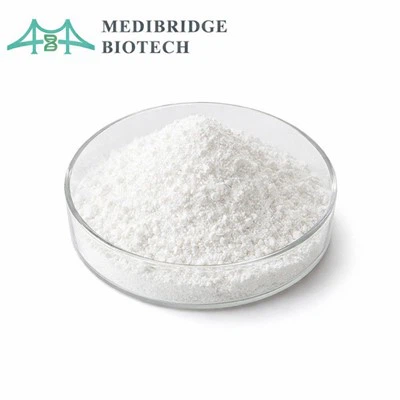
Sodium Copper Chlorophyllin Powder, SCC, is a water-soluble green pigment derived from natural chlorophyll. It is made from natural chlorophyll (mainly from mulberry leaves, alfalfa, and other plants) through copper replacement of magnesium ions, alkaline hydrolysis, and sodium salting. It is a safe, stable, water-soluble pigment from natural sources and is widely used in many fields, such as food, medicine, and cosmetics. Its good stability makes it more suitable for industrial production than natural chlorophyll, and many regulatory agencies worldwide have recognized it. Within reasonable use, sodium copper chlorophyllin is a safe and healthy food additive and functional ingredient.
Shaanxi Medibridge Biotech Co., Ltd. focuses on the supply of pharmaceutical raw materials and research-use compounds. We support customers with stable quality, clear specification communication, flexible packaging options, and document-related support for different project stages.
COA
|
|
||
|
Product Name |
CAS Number |
Batch Number |
|
Sodium Copper Chlorophyllin Powder |
28302-36-5 |
MB2606130845 |
|
Manufacturer Date |
Analysis Date |
Expiry Date |
|
2026/6/13 |
2026/6/15 |
2028/6/15 |
|
Sample Qty Base |
Packing |
Test Method |
|
100KGS |
25KG/drum |
HPLC |
|
|
||
|
Item |
Standard |
Results |
|
Appearance |
Dark green fine powder |
Complies |
|
Sodium copper chlorophyllin |
98%min |
101.5% |
|
E1%1%1cm405nm Absorptance |
≥568 |
577 |
|
Extinction Ratio |
3.0-3.9 |
3.8 |
|
Total Copper % |
≤8.0 |
4.6 |
|
Nitrogen determination % |
≥4.0 |
4.8 |
|
Sodium % |
5.0%-7.0% on dried base |
5.9 |
|
Limit of ionic copper % |
≤0.25% on dried base |
0.012 |
|
Residue on ignition % |
≤30 on dried base |
26.5 |
|
Arsenic |
≤3.0ppm |
0.4ppm |
|
Lead |
≤5.0ppm |
0.5ppm |
|
Mercury |
≤1ppm |
0.21ppm |
|
Iron % |
≤0.5 |
0.06 |
|
PH (1% solution) |
9.5-10.7(in a solution 1 in100) |
10.4 |
|
Loss Drying % |
≤5.0(at 105°C for 2 hours) |
2.6 |
|
Test for fluorescence |
No fluorescence is visible |
Complies |
|
Total Plate Count cfu/g |
≤1000 |
Complies |
|
Yeast cfu/g |
≤100 |
Complies |
|
Mold cfu/g |
≤100 |
Complies |
|
Salmonella |
Not detected in 25g |
Negative |
|
E. Coli |
Not detected in 25g |
Negative |
|
Conclusion |
The batch conforms to the IN-HOUSE standard |
|
|
|
||


Compositional Complexity
Commercial sodium copper chlorophyllin contains a mixture of copper chlorophyllin components. Their proportions, along with the amounts of other constituents, can vary with the plant source, manufacturing process, and purification method. These differences may affect color, absorption spectra, stability, and biological exposure. EFSA has identified more precise characterization of the compounds present in E 141(ii) as an important specification issue.
A professional specification should distinguish total copper chlorophyllins, the individual component profile, total copper, free copper, and non-pigment impurities. Acceptable total copper does not establish acceptable free copper, and two batches with a similar shade of green are not necessarily compositionally equivalent.

Physicochemical Properties and Color Formation

Sodium copper chlorophyllin appears as a dark green to nearly black powder. Its conjugated pigment structures absorb selected wavelengths of visible light, producing a green appearance. Compared with native chlorophyll, its salt-form components are better suited to aqueous formulation research.
"Water-soluble," however, does not guarantee identical behavior in every product. Concentration, pH, temperature, salts, other formulation ingredients, and storage time can affect shade, clarity, and precipitation. Practical characterization should cover dissolution time, absorbance spectrum, color coordinates, pH-dependent behavior, and the appearance of both freshly prepared and stored solutions.
Stability: Copper Coordination Does Not Prevent All Degradation
Copper coordination contributes to the practical stability of this pigment class, but sodium copper chlorophyllin should not be described as completely resistant to acid, heat, or light. A study of commercial-grade material tracked changes during heating by UV–visible spectroscopy and HPLC, demonstrating the need to validate stability under the intended processing conditions.
Stability testing should measure more than whether a product still looks green. Useful endpoints include instrumental color difference, absorbance spectra, HPLC component profiles, free copper, and evidence of precipitation. Testing should be conducted in the actual product matrix and packaging. Research into alginate and xanthan gum, for example, has explored ways to improve color stability in acidic formulations; the result must still be confirmed for each finished product.

Research Applications

Food Coloring and Formulation Research
Where the intended use is permitted, sodium copper chlorophyllin can be evaluated as a green colorant for aqueous products and dry mixes. The same addition level may yield different color and stability in a clear beverage, an opaque beverage, a gel, or a reconstituted powder. Formulators should therefore assess the pigment in the finished matrix, including its response to processing and storage.
Interactions with Foreign Compounds and Aflatoxin Research
One research interest is whether chlorophyllin preparations can alter the disposition of certain ingested compounds. In a randomized, double-blind, placebo-controlled study involving 180 adults in Qidong, China, investigators measured a urinary biomarker of aflatoxin-related DNA damage. The chlorophyllin group had a lower median level of that biomarker than the placebo group under the study conditions.


Photodynamic and Antimicrobial Research
The visible-light absorption of sodium copper chlorophyllin has prompted research into its use as a photosensitizer. Laboratory studies have combined it with defined light exposure and examined effects on Staphylococcus aureus and other microorganisms. An Escherichia coli study also investigated oxidative-damage-related endpoints following photodynamic
Cosmetics and Personal Care Research
Sodium copper chlorophyllin can be studied for green coloration, formulation aesthetics, and the stability of copper chlorophyllin derivatives in topical products. A small, single-center pilot study investigated a topical liposomal dispersion containing a sodium copper chlorophyllin complex. Its findings cannot automatically be transferred to a conventional powder added to a different cream, serum, or cleanser.

FAQ
What is sodium copper chlorophyllin good for?
Sodium copper chlorophyllin is a water-soluble, semi-synthetic derivative of plant chlorophyll used primarily as an internal deodorant, a wound-healing aid, and a natural green colorant.
Can I drink chlorophyll every day?
Yes, you can safely drink chlorophyll every day.
What are the potential side effects of taking chlorophyllin copper sodium?
Copper chlorophyllin is generally well-tolerated in normal amounts, but higher doses or supplements can cause mild digestive upset, harmless body fluid discoloration, and increased sun sensitivity.
What are the benefits of taking chlorophyll powder?
Taking chlorophyll powder may provide antioxidant effects, support skin healing, and help neutralize body odor, though strong human evidence for many claims remains limited.
Hot Tags: sodium copper chlorophyllin powder, China sodium copper chlorophyllin powder manufacturers, suppliers, factory, cilostazol pharmaceutical research material, gabapentin drug substance, gabapentin medicinal chemical powder, heparin sodium formulation ingredient powder, mirabegron research powder, Phenibut Bulk Powder