


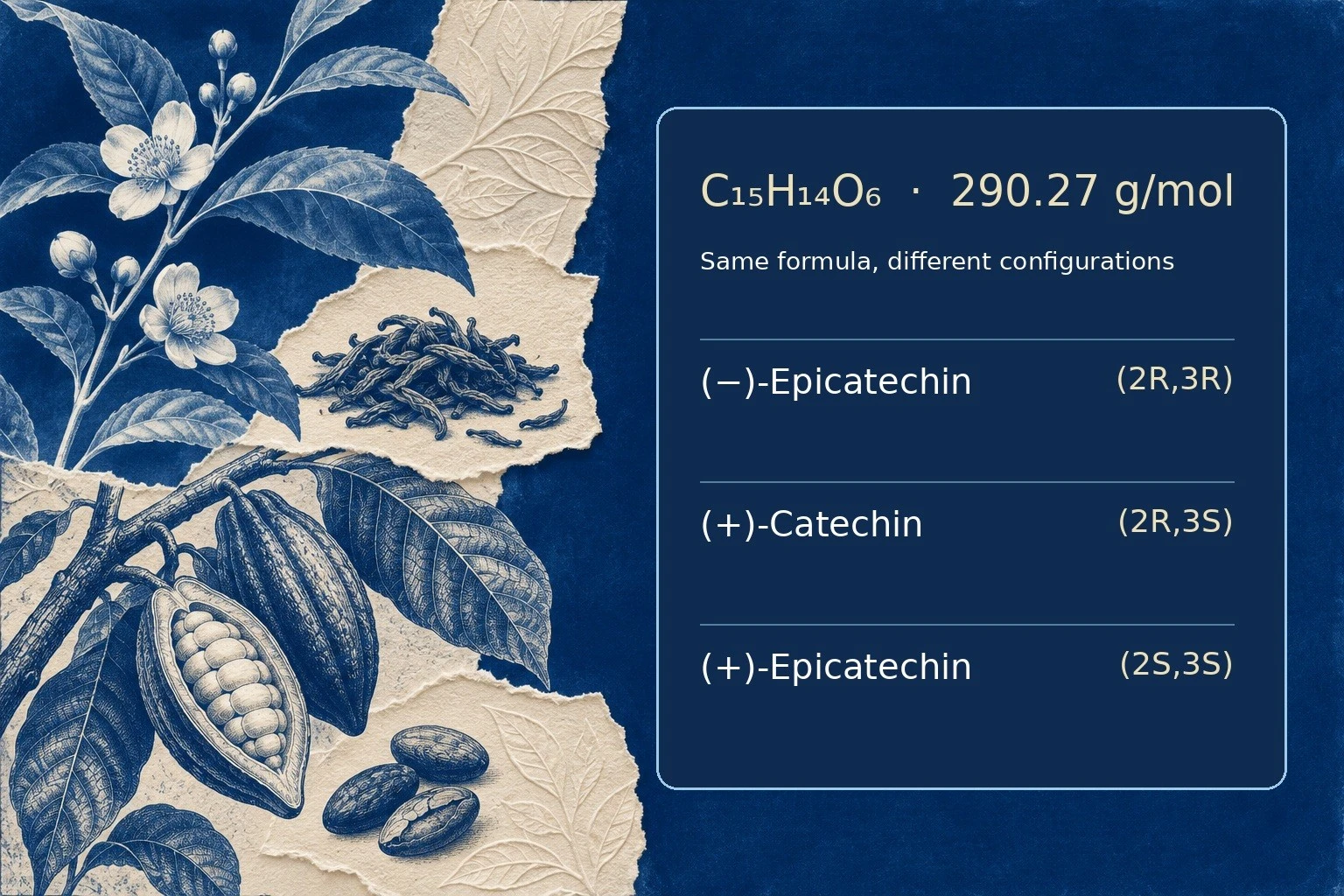
Molecular Identity and Stereochemistry
(−)-Epicatechin has the molecular formula C₁₅H₁₄O₆ and a molar mass of 290.27 g/mol. Its two stereocenters have the (2R,3R) configuration. (+)-Catechin has the same formula and atom connectivity but differs at carbon 3, giving it the (2R,3S) configuration. (+)-Epicatechin, meanwhile, is the mirror image of (−)-epicatechin and has the (2S,3S) configuration. A mass measurement alone cannot distinguish these forms. When a powder is specified as (−)-epicatechin, researchers can use an enantioselective separation with reference standards to check which stereoisomers are present.
How Cocoa Processing Changes the Flavanol Profile
Studies of cacao beans and cocoa ingredients show that roasting and alkalization can change the relative amounts of flavan-3-ol stereoisomers. In one study, the (−)-catechin to (−)-epicatechin peak-area ratio was 18:82 in a roasted bean sample and 42:58 and 65:35 in two alkalized cocoa powders. These are ratios between two analytical peaks in specific samples. They cannot establish how much epicatechin was lost during processing, since that requires absolute concentrations measured on comparable samples. The researchers linked the appearance of (−)-catechin during processing to epimerization, a change in configuration at one stereocenter.


Why Epicatechin Solutions Can Turn Brown
In a model solution study, epicatechin underwent auto-oxidation and developed brown color without active oxidative enzymes. Researchers paired reversed-phase UHPLC with photodiode array detection and mass spectrometry to investigate the products, identifying signals consistent with epicatechin dimers and trimers. Color and chromatography answer different questions in this setting. Color records the overall appearance of the solution, while chromatographic measurements can track the remaining parent compound and the emergence of individual products. The results describe the tested solutions. A dry powder requires separate stability measurements under its own storage conditions.
What a Powder Assay Can Tell You
A compound-specific assay can quantify (−)-epicatechin against a reference standard, provided the method resolves any related compounds that would otherwise contribute to its signal. A validated chiral separation can also determine whether the opposite enantiomer is present. The reporting basis matters when comparing powder lots. An as-is result expresses epicatechin per gram of powder as received, while a dry-basis result adjusts for measured moisture. Reporting the assay basis and the method used to establish stereochemical identity makes it easier to compare powders prepared or stored under different conditions.


Tracing Epicatechin-Derived Metabolites
A human tracer study used carbon-14-labeled (−)-epicatechin to follow the compound after ingestion. Over 48 hours, researchers recovered 82 ± 5% of the ingested radioactivity in urine and 95 ± 1% in urine and feces combined. These percentages describe recovery of the label, which can be carried by metabolites. Unchanged epicatechin was below the study's detection limits in plasma and urine, while the researchers characterized more than 20 metabolites across those samples. The tracer therefore helped account for material derived from epicatechin even when the parent compound was undetectable.
Shaanxi Medibridge Biotech Co., Ltd. is dedicated to supplying a wide range of research-grade products-including peptides, chemical compounds, and extracts - to laboratories, academic institutions, and biotechnology organizations worldwide. If you are seeking a partner for high-purity raw materials to establish a long-term collaboration, please email hi@medibridgeapi.com.


