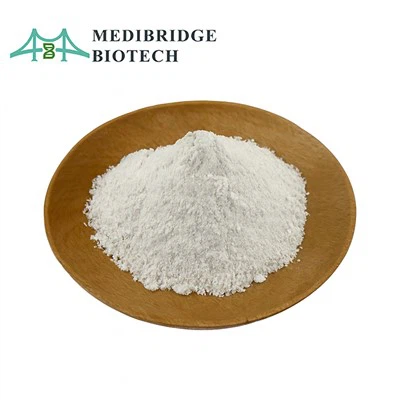
Harringtonine Powder, or HRT,Cepholotoxine, is an alkaloid extracted from the plant Cephalotaxus or its congeners and belongs to a group of drugs called protein synthesis inhibitors. It inhibits protein synthesis by interfering with ribosome function in diseased cells. Ribosomes are the essential tissue structure in cells responsible for protein synthesis. They are composed of ribonucleic acid and proteins. Cepholotoxine affects the protein synthesis process by binding to specific subunits of ribosomes, thereby inhibiting the growth and division of diseased cells.
Shaanxi Medibridge Biotech Co., Ltd. supplies plant extracts, nutritional ingredients, and custom specification products for different sourcing and formulation needs. We support stable supply, routine specification matching, and flexible packaging service for ingredient-based product development.
COA
|
|
||
|
Product Name |
CAS Number |
Batch Number |
|
Harringtonine Powder |
26833-85-2 |
MB2604150664 |
|
Manufacturer Date |
Analysis Date |
Expiry Date |
|
2026/4/15 |
2026/4/16 |
2028/4/15 |
|
Sample Qty Base |
Packing |
Test Method |
|
150KGS |
25KG/drum |
HPLC |
|
|
||
|
Item |
Standard |
Results |
|
Assays |
98% |
98.36% |
|
Appearance |
White powder |
Complies |
|
Identification |
Complie with standard |
Complies |
|
Odor&Taste |
Characteristic |
Complies |
|
Particle Size |
100% Pass 80 Mesh |
Complies |
|
Loss on Drying |
≤5.0% |
3.45% |
|
Ash |
≤5.0% |
2.14% |
|
Heavy metals |
≤20.0ppm |
Complies |
|
Extract solvent |
Water& ethanol |
Complies |
|
Total Mercury(Hg) |
≤0.1ppm |
Complies |
|
Total Plate Count |
≤1,000cfu/g |
Complies |
|
Yeast & Mold |
≤100cfu/g |
Complies |
|
E.Coli |
Negative |
Negative |
|
Salmonella |
Negative |
Negative |
|
Conclusion |
The batch conforms to the IN-HOUSE standard |
|
|
|
||


Physicochemical Properties
Harringtonine is generally supplied as a white to off-white or pale-yellow powder or amorphous solid. Its appearance may vary depending on purity, residual solvents, oxidation level, and drying process.
Key Physicochemical Characteristics
- It contains multiple oxygen-containing functional groups but also possesses a complex, relatively hydrophobic polycyclic skeleton.
- Its practical solubility in pure water is generally limited.
- It is usually easier to prepare in DMSO, methanol, and certain aqueous organic solvent systems.
- The molecule contains multiple stereogenic centers, making stereochemical integrity an important aspect of biological activity and quality control.
- Its ester linkage may be susceptible to hydrolysis under inappropriate conditions.
- Prolonged exposure to light, heat, extreme pH, or moisture may promote degradation.
- Concentrated stock solutions may crystallize, precipitate, or adsorb onto container surfaces during low-temperature storage.

Core Molecular Mechanism - Inhibition of Eukaryotic Protein Translation

The principal biological action of Harringtonine is the inhibition of ribosome-mediated protein synthesis in eukaryotic cells.
The Mechanism Can Be Summarized as Follows
- Harringtonine interacts with a functional region of the eukaryotic ribosome.
- It interferes with aminoacyl-tRNA accommodation or early peptide-bond formation.
- Newly recruited ribosomes are unable to enter the open reading frame efficiently.
- Ribosomes already positioned downstream continue elongation and gradually run off the mRNA.
- Global synthesis of new proteins subsequently declines.
Downstream Biological Effects
Following translation inhibition, proteins with short intracellular half-lives are often among the first to decline. These may include:
- Cell-cycle regulatory proteins;
- Anti-apoptotic proteins;
- Growth- and survival-signaling proteins;
- Selected oncogenic proteins;
- Short-lived proteins required for inflammatory signaling or viral replication.
The resulting effects may include cell-cycle arrest, mitochondrial stress, suppression of proliferation, and apoptosis.
However, these responses are generally downstream consequences of global or selective translation inhibition. They do not necessarily indicate that Harringtonine directly binds to each affected signaling protein.

Translational Biology & Molecular Research Tool

One of the most established and distinctive applications of Harringtonine is its use as a translation-initiation mapping tool in ribosome profiling, also known as Ribo-seq.
Basic Experimental Principle
Following brief exposure to Harringtonine:
- Newly initiating ribosomes become arrested near translation-start sites;
- Ribosomes already located within coding regions continue elongating and run off the mRNA;
- Ribosome-protected fragments become enriched near translation-initiation sites;
- Sequencing and mapping of these fragments can be used to infer the positions of translation-start sites.
Research Applications
Harringtonine-assisted Ribo-seq can support investigations into:
- Global translation regulation;
- Stress-induced changes in translation initiation;
- Cancer-associated translational reprogramming;
- Viral dependence on host-cell translation;
- Alternative protein isoform production;
- Functional annotation of previously unrecognized coding regions;
- Translation of upstream open reading frames;
- Drug-induced changes in the translatome.

Pharmacological Activities & Research Evidence

Antitumor Research
In vitro, Harringtonine can suppress protein synthesis in rapidly proliferating cells and may induce several downstream responses.
Because malignant cells may depend heavily on continuous production of short-lived oncogenic and survival proteins, inhibition of translation can produce substantial antiproliferative effects.
Nevertheless, Harringtonine is not inherently selective for malignant cells. Normal proliferating cells may also be affected, which can limit the therapeutic window.
Antiviral Research
Viruses depend extensively on host-cell ribosomes to synthesize viral proteins. By suppressing translation, Harringtonine may reduce viral protein production and viral replication in selected cell-based models.
Potential research mechanisms include:
- Reduction of viral structural-protein synthesis;
- Suppression of viral enzyme production;
- Interference with viral polyprotein processing;
- Decreased assembly or release of progeny viral particles;
- Disruption of short-lived host proteins required for viral replication.
However, its antiviral activity must be interpreted cautiously because the same mechanism can also suppress essential host-cell protein synthesis.

FAQ
What is the core mechanism of action of Harringtonine?
It acts as a specific inhibitor of the eukaryotic 60S ribosomal subunit (A-site), rapidly and selectively blocking the protein translation process.
What are the main research applications for Harringtonine Powder?
It is primarily utilized in hematological malignancy research, protein turnover/remodeling studies, and ribosome profiling experiments.
Which solvents are recommended for reconstituting and dissolving this product?
Reconstitution in anhydrous DMSO or methanol is recommended for stock solutions; its aqueous solubility is extremely low, so for aqueous working buffers, dissolve first in a minimal volume of DMSO or slightly acidic buffer before diluting.
How should reconstituted Harringtonine stock solutions be stored and handled?
Stock solutions should be aliquoted for single use and stored protected from light at -80°C to avoid repeated freeze-thaw cycles, and should not be exposed to alkaline conditions to prevent ester bond hydrolysis.
If you are looking for a high-quality Harringtonine Powder manufacturer with whom you can establish a long-term, stable partnership, then Shaanxi Medibridge Biotech Co., Ltd. would be your best business partner. Don't hesitate to contact us at hi@medibridgeapi.com.
Hot Tags: harringtonine powder, China harringtonine powder manufacturers, suppliers, factory, corosolic acid bulk raw material, epicatechin stabilized powder, ginkgo biloba extract tablet ingredient, Ginsenoside CK, grape seed extract standardized OPC, hesperidinase citrus flavonoid enzyme powder