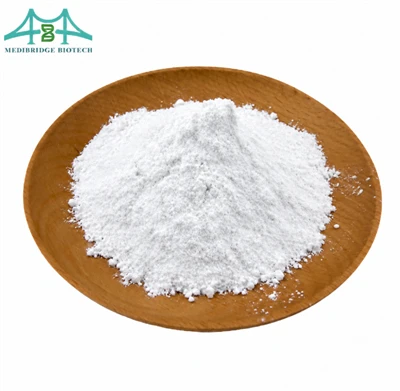
Hyperoside Powder is a natural compound belonging to a group of flavonoid compounds known as flavonol glycosides. It can be found in various plant sources, including fruits, vegetables, and medicinal herbs. Hyperoside is recognized for its potential health benefits and is widely studied for its antioxidant, anti-inflammatory, and neuroprotective properties.
Research suggests that hyperoside exhibits potent antioxidant activity. Antioxidants help protect our cells from oxidative stress caused by an imbalance between free radicals and the body's antioxidant defenses. Oxidative stress is implicated in various chronic diseases, including heart disease, cancer, and neurodegenerative disorders. By neutralizing free radicals, hyperoside may help reduce the risk of these diseases and promote overall health and well-being.
Shaanxi Medibridge Biotech Co., Ltd. supplies plant extracts, nutritional ingredients, and custom specification products for different sourcing and formulation needs. We support stable supply, routine specification matching, and flexible packaging service for ingredient-based product development.
COA
|
|
||
|
Product Name |
CAS Number |
Batch Number |
|
Hyperoside Powder |
482-36-0 |
MB2604151655 |
|
Manufacturer Date |
Analysis Date |
Expiry Date |
|
2026/4/15 |
2026/4/16 |
2028/4/15 |
|
Sample Qty Base |
Packing |
Test Method |
|
100KGS |
25KG/drum |
HPLC |
|
|
||
|
Item |
Standard |
Results |
|
Appearance |
Brown yellow powder |
Conforms |
|
Assay |
30% |
31.65% |
|
Identification |
Characteristic |
Characteristic |
|
Melting point |
225-226℃ |
225.5℃ |
|
Particle size |
100% through 80 mesh |
80 mesh |
|
Residue on ignition |
≤0.5% |
0.06% |
|
Loss on drying |
≤2.0% |
0.67% |
|
Heavy metal |
≤15ppm |
3ppm |
|
Lead(Pb) |
≤1ppm |
Complies |
|
Arsenic(As) |
≤2ppm |
Complies |
|
Mercury(Hg) |
Not detected |
Not detected |
|
Pesticide residue |
Not detected |
Not detected |
|
Total bacteria count |
≤1000cfu/g |
70cfu/g |
|
Fungi |
≤100cfu/g |
<15cfu/g |
|
Samonella |
Negative |
Negative |
|
Related substances |
Single impurity≤0.2% |
0.03% |
|
Total impurities≤0.5% |
0.12% |
|
|
Conclusion |
The batch conforms to the IN-HOUSE standard |
|
|
|
||


Physicochemical Properties
Hyperoside contains multiple hydroxyl groups and therefore possesses a certain degree of hydrophilicity. However, its aromatic flavonoid skeleton limits its practical solubility and dispersibility in pure water.
Key formulation characteristics include:
- It generally exhibits better solubility in methanol, aqueous ethanol, DMSO, and similar solvent systems than in pure water.
- In aqueous formulations, it may dissolve slowly, precipitate at low temperatures, or sediment during prolonged storage.
- It may be affected by light, oxygen, metal ions, formulation pH, and processing temperature.
- Although alkaline conditions may improve its apparent solubility, they may also accelerate oxidation or structural degradation. Short-term dissolution performance alone should therefore not be used to determine stability.
- Contact with transition metals such as iron and copper may cause complexation or catalyze oxidation.
- The powder may absorb moisture, form agglomerates, or gradually darken during storage.

Antioxidant Mechanisms

The core structure of Hyperoside contains multiple phenolic hydroxyl groups and a catechol-type B ring. These structural characteristics enable it to donate hydrogen atoms or electrons and stabilize reactive radical intermediates.
Antioxidant mechanisms reported in experimental studies include:
- Direct scavenging of reactive oxygen species and free radicals
- Reduction of membrane lipid peroxidation
- Decreased formation of oxidative-damage markers such as malondialdehyde
- Preservation or restoration of endogenous antioxidant systems, including SOD, CAT, GSH, and related glutathione-dependent enzymes
- Activation of the Nrf2/HO-1 antioxidant defense pathway
- Protection of mitochondrial membrane potential
- Reduction of oxidative DNA, protein, and cellular membrane damage
Its glycoside structure can influence aqueous behavior, cellular uptake, metabolism, and antioxidant performance relative to quercetin and other quercetin glycosides.
However, chemical antioxidant assays such as DPPH, ABTS, or radical-scavenging tests cannot be directly translated into human efficacy. Actual biological activity depends on gastrointestinal absorption, metabolism, tissue distribution, achievable concentration, and the formulation used.
Anti-inflammatory Mechanisms
Cellular and animal studies indicate that Hyperoside may regulate inflammation through several interacting signaling pathways.
Reported mechanisms include:
- Inhibition of IκB-α degradation
- Reduction of NF-κB activation and nuclear translocation
- Modulation of the p38, JNK, and ERK branches of the MAPK pathway
- Downregulation of pro-inflammatory cytokines such as TNF-α, IL-1β, and IL-6
- Reduced expression of inducible nitric oxide synthase and cyclooxygenase-2
- Regulation of the TLR4/MyD88 signaling pathway in certain experimental models
- Suppression of NLRP3 inflammasome activation in selected models
- Modulation of SIRT1-related inflammatory and cellular stress pathways
- Coordinated regulation of Nrf2 and NF-κB signaling, potentially reducing both oxidative stress and inflammatory responses
Experimental studies have shown that Hyperoside can suppress NF-κB activation and IκB-α degradation. Other studies suggest that its protective effects may involve the SIRT1/NF-κB and Nrf2/ARE signaling pathways.

Investigated Biological Activities
|
Research Area |
Proposed Mechanisms |
Current Evidence Level |
|
Cardiovascular protection |
Antioxidant activity, endothelial protection, regulation of vascular inflammation, and reduction of ischemia–reperfusion injury |
Mainly cellular and animal studies |
|
Hepatoprotection |
Reduction of oxidative stress, lipid accumulation, inflammation, and hepatocyte injury |
Substantial preclinical research |
|
Neuroprotection |
Reduction of neuroinflammation, mitochondrial protection, regulation of apoptosis, and attenuation of oxidative damage |
Preclinical evidence |
|
Renal protection |
Antioxidant, anti-inflammatory, anti-fibrotic, and mitochondrial protective effects |
Cellular and animal studies |
|
Bone and cartilage protection |
Inhibition of inflammation, extracellular matrix degradation, endoplasmic-reticulum stress, and apoptosis |
Cellular and animal studies |
|
Antitumor research |
Regulation of cell-cycle progression, apoptosis, migration, invasion, and selected signaling pathways |
Experimental research only; not evidence of clinical anticancer efficacy |
|
Antiviral and antimicrobial research |
Interference with pathogen replication or modulation of host inflammatory responses |
Early-stage research |
|
Sleep and mood support |
Investigated through Hyperoside-rich botanical preparations and combination products |
Very limited human evidence |
A short-term randomized study has investigated Hyperoside-rich blueberry leaf tea in adults with poor sleep continuity. However, the results apply to that specific botanical preparation and cannot be directly attributed to purified Hyperoside Powder.
Potential Applications
- Standardization of botanical extracts and quality control of herbal raw materials;
- Antioxidant and anti-inflammatory mechanism research;
- Development of dietary supplements and functional foods;
- Skincare, soothing, and antioxidant formulations;
- Research on liposomes, nanoemulsions, and phospholipid complexes;
- Drug lead compounds and pharmacological research tools;
- Reference standards for HPLC and LC-MS analysis.

FAQ
What is the solubility profile of this product in laboratory experiments?
It is easily soluble in DMSO and methanol, but sparingly soluble in water; we recommend preparing a DMSO stock solution before diluting for cell or animal assays.
What is the recommended working concentration for in vitro cell assays?
The typical working concentration ranges from 1 to 50 umol/L, which should be optimized based on your specific cell lines and preliminary IC50 toxicity testing.
What are the primary molecular mechanisms of Hyperoside in pharmacological research?
It acts primarily by activating the Nrf2/HO-1 signaling pathway to exert antioxidant effects and suppressing the NF-kB pathway to reduce pro-inflammatory cytokine expression.
What are the recommended storage conditions to ensure chemical stability?
Store sealed in a dark, dry place at -20C to prevent degradation from galactoside hydrolysis and phenol oxidation.
If you are looking for a high-quality Hyperoside Powder manufacturer with whom you can establish a long-term, stable partnership, then Shaanxi Medibridge Biotech Co., Ltd. would be your best business partner. Don't hesitate to contact us at hi@medibridgeapi.com.
Hot Tags: hyperoside powder, China hyperoside powder manufacturers, suppliers, factory, bromelain food enzyme ingredient, epicatechin organic compound, ginkgo biloba extract health ingredient, ginkgo biloba extract tablet ingredient, guayusa leaf extract raw material, Pure Carotene Powder