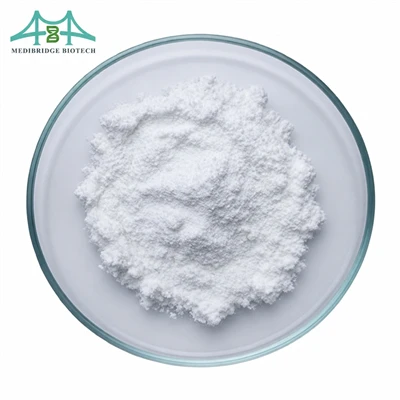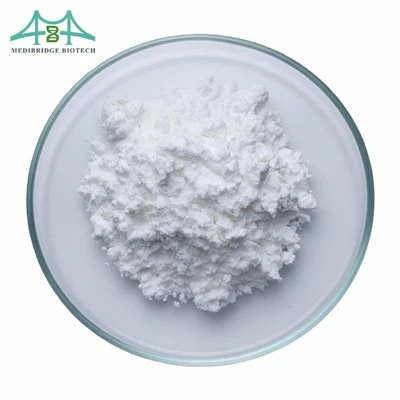


Apremilast Powder is a phosphodiesterase 4 (PDE4) inhibitor class drug. It primarily treats certain autoimmune diseases, including moderate to severe psoriasis and psoriatic arthritis. Psoriasis is a long-term skin condition that can recur and be brought on by various factors, including immune system abnormalities, endocrine disorders, infections, and heredity. It mainly manifests as erythema, chills, joint pain, swelling, desquamation, etc. There is no specific treatment for psoriasis, and it can be controlled and alleviated through drug treatment, physical therapy, etc. It relieves swelling, joint pain, stiffness, and other conditions caused by the disease. Psoriatic arthritis is a related disease that affects some people with psoriasis and causes joint inflammation and pain.
Shaanxi Medibridge Biotech Co., Ltd. focuses on the supply of pharmaceutical raw materials and research-use compounds. We support customers with stable quality, clear specification communication, flexible packaging options, and document-related support for different project stages.
COA
|
|
||
|
Product Name |
CAS Number |
Batch Number |
|
Apremilast Powder |
608141-41-9 |
MB2608082569 |
|
Manufacturer Date |
Analysis Date |
Expiry Date |
|
2026/8/08 |
2026/8/09 |
2028/8/08 |
|
Sample Qty Base |
Packing |
Test Method |
|
650GS |
10GS/bottle |
HPLC |
|
|
||
|
Item |
Standard |
Results |
|
Appearance |
White powder |
Conform |
|
Related substances |
Any single unknown impurity≤0.1% |
0.09% |
|
Enantiomer |
0.05%nax |
0.12% |
|
Loss on drying |
0.05%max |
0.03% |
|
Melting point |
154~158°C |
Conform |
|
Residue on ignition |
0.5%max |
0.01% |
|
Residual solvents |
Methan < 3000ppm |
560ppm |
|
Assay |
99.0%min |
99.87% |
|
Conclusion |
The batch conforms to the IN-HOUSE standard |
|
|
|
||


PDE4 Inhibition and Enzyme Kinetics
Phosphodiesterase 4 (PDE4) hydrolyzes cyclic adenosine monophosphate (cAMP) to 5'-AMP. Apremilast slows this reaction, allowing cAMP to accumulate when cells continue to produce it. In a partially purified PDE4 preparation from the human U937 monocytic cell line, Schafer and colleagues measured an IC50 of 74 ± 34 nM using 1 μM cAMP as the substrate. The reported Kᵢ was 68 ± 26 nM. Enzyme activity recovered after dilution, supporting reversible inhibition.

Structural Evidence from the PDE4D–Apremilast Complex

The Protein Data Bank entry 7CBQ contains an X-ray crystal structure of apremilast bound to the human PDE4D catalytic domain at 1.59 Å resolution. The structure shows the ligand's orientation within the catalytic pocket and provides a basis for identifying nearby residues and proposing interactions for experimental testing. It can also guide structure–activity studies of apremilast analogues.
Because the crystallized construct contains the catalytic domain, experiments with full-length PDE4D are needed to examine how regulatory regions influence inhibition or conformational changes.
Intracellular cAMP, PKA, and EPAC Signaling
In the murine macrophage cell line RAW 264.7, apremilast increased intracellular cAMP and reduced lipopolysaccharide (LPS)-stimulated TNF-α release, with an IC50 of approximately 104 nM for the TNF-α endpoint. Knockdown experiments supported contributions from protein kinase A (PKA) and the cAMP-responsive exchange proteins EPAC1 and EPAC2 under the conditions tested.
A time-course study can measure cAMP at early time points, then assess transcription or protein secretion later. Measure cell number and viability alongside the signaling endpoints.

Polymorphism, Particle Size and Powder Characterization
Apremilast exhibits solid-state polymorphism. One study characterized Forms B and E and used solubility measurements to investigate their thermodynamic properties. A separate study examined 19 isostructural multicomponent solids, including cocrystals and solvates, and compared melting behavior, intrinsic dissolution rate, and thermodynamic solubility. Report both the composition and the crystalline form when interpreting these comparisons, since cocrystals and solvates contain additional components.
|
Research question |
Analytical approach |
|
Do two powder batches have the same crystalline form? |
Compare X-ray powder diffraction (XRPD) patterns with a verified reference. |
|
Does a thermal event coincide with mass loss? |
Combine differential scanning calorimetry (DSC) with thermogravimetric analysis (TGA). |
|
Does micronization change particle size or crystalline form? |
Measure D10, D50, and D90 by laser diffraction and compare XRPD patterns before and after processing. |
|
How does the powder respond to humidity? |
Measure moisture uptake by dynamic vapor sorption (DVS) and use Karl Fischer titration or XRPD as needed. |
Biotransformation and Metabolite Tracking

In a human 14C tracer study, unchanged apremilast accounted for approximately 45% of total plasma radioactivity exposure, and its major metabolite, O-desmethyl apremilast glucuronide (M12), accounted for approximately 39%. The study also identified products formed through pathways including O-deethylation, N-deacetylation, hydroxylation, and hydrolysis. Both percentages use total plasma radioactivity exposure as the denominator.
An in vitro time course can track the parent compound, the O-desmethyl intermediate, and its glucuronide. Quantitative LC–MS comparisons should account for compound-specific response factors and matrix effects. In the published study, β-glucuronidase hydrolysis of isolated M12 yielded the O-desmethyl metabolite, which was identified by LC–MS and provided additional evidence for the conjugate's structural assignment.
FAQ
What is apremilast used for?
Apremilast (commonly known by its brand name Otezla) is an oral, non-biologic prescription medication.
Is apremilast good for psoriasis?
Yes, apremilast (known by the brand name Otezla) is an effective and widely used oral medication for plaque psoriasis.
Is apremilast a steroid?
No, apremilast (sold under the brand name Otezla) is not a steroid.
Which organ is affected by psoriasis?
Psoriasis primarily affects the skin and nails, as it is an immune-mediated condition that causes skin cells to multiply too rapidly, forming thick, scaly plaques.
If you are looking for a high-quality Apremilast Powder manufacturer with whom you can establish a long-term, stable partnership, then Shaanxi Medibridge Biotech Co., Ltd. would be your best business partner. Don't hesitate to contact us at hi@medibridgeapi.com.
Hot Tags: apremilast powder, China apremilast powder manufacturers, suppliers, factory, mirabegron bioactive pharmaceutical ingredient, picamilon raw material, pregabalin pharmaceutical powder, Progesterone Powder, rapamycin drug formulation ingredient, rapamycin high purity powder