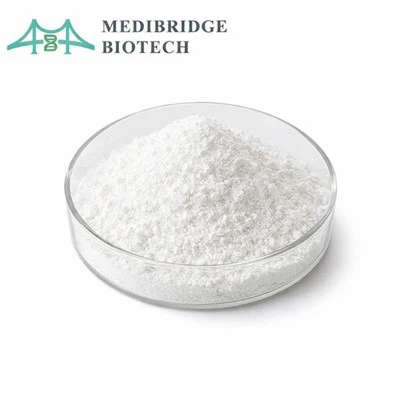
Loperamide HCl Powder is a widely used active pharmaceutical ingredient (API) in antidiarrheal medications, belonging to the peripherally acting opioid receptor agonist class. At standard therapeutic levels, it does not produce central opioid effects like analgesia or addiction since it mainly works on the intestines and barely penetrates the central nervous system. Because of this feature, it is a traditional medication used to treat both acute and chronic diarrhea.
Pharmacologically, this product inhibits the release of neurotransmitters like acetylcholine by activating μ-opioid receptors in intestinal smooth muscle cells and the enteric nervous system. This prolongs the transit time of intestinal contents and decreases the frequency of intestinal peristalsis. It also improves the tone of the anal sphincter, which lowers the frequency of defecation and increases the consistency of the stool. Under normal conditions, it does not produce central nervous system depression because of its extremely poor penetration through the blood-brain barrier and its role as a substrate of P-glycoprotein.
Shaanxi Medibridge Biotech Co., Ltd. focuses on the supply of pharmaceutical raw materials and research-use compounds. We support customers with stable quality, clear specification communication, flexible packaging options, and document-related support for different project stages.
COA
|
|
||
|
Product Name |
CAS Number |
Batch Number |
|
Loperamide HCl Powder |
34552-83-5 |
MB2606131201 |
|
Manufacturer Date |
Analysis Date |
Expiry Date |
|
2026/6/13 |
2026/6/15 |
2028/6/15 |
|
Sample Qty Base |
Packing |
Test Method |
|
100KGS |
25KG/drum |
HPLC |
|
|
||
|
Item |
Standard |
Results |
|
Appearance |
Off white to pale yellow powder |
Conforms |
|
Solubility |
Meets the requirements |
Meets the requirements |
|
Identification |
Infrared spectrum should conform |
Conforms |
|
|
Should conform |
Conforms |
|
Assay |
95.0%-102.0% |
99.6% |
|
Specific rotation |
+58°~+64° |
+61° |
|
Loss on drying |
≤3.0% |
2.3% |
|
PH |
4.5~6.5 |
5.0 |
|
Moisture content |
≤6.0% |
< 4.6% |
|
Absorbance |
≤0.2% |
Conforms |
|
Any individual impurity |
≤1.0% |
0.38% |
|
Sum of all impurities |
≤3.0% |
1.4% |
|
Bacterial endotoxins |
≤0.2USP EU/mg |
Conforms |
|
Sterility |
Meets the requirements |
Meets the requirements |
|
Conclusion |
The batch conforms to the IN-HOUSE standard |
|
|
|
||


Intestinal Pharmacology and Mechanism
Loperamide acts primarily at opioid receptors in the gut wall. It inhibits the release of mediators including acetylcholine and prostaglandins, reduces propulsive peristalsis, and lengthens intestinal transit time. Its pharmacological effects also include changes in the movement of water and electrolytes through the bowel and increased anal sphincter tone. These actions explain its established role in symptomatic control of diarrhea; they do not address every underlying cause of diarrhea.
A mechanism study can examine more than stool frequency. Relevant measures include transit time, secretion and absorption, enteric neuronal signaling, and receptor-dependent changes in intestinal tissue. The experimental model matters because an isolated-cell response may not predict the integrated response of a functioning bowel.

Absorption, Distribution, and the Blood–Brain Barrier

A central feature of loperamide research is the difference between strong local intestinal activity and relatively low circulating concentrations at labeled doses. In one current U.S. capsule label, plasma concentrations of unchanged loperamide remain below 2 ng/mL after a 2 mg capsule. The label reports approximately 95% plasma protein binding and identifies loperamide as a P-glycoprotein substrate.
P-glycoprotein is particularly relevant when interpreting distribution and interaction experiments, including work on transport at the blood–brain barrier. Researchers should distinguish limited exposure under ordinary labeled conditions from an absolute inability to reach the central nervous system. Exposure can change when transport or metabolism is inhibited, or when doses exceed recommendations.
Metabolism and Drug-Interaction Research
Loperamide is eliminated mainly through oxidative N-demethylation. In vitro data cited in the product label identify CYP2C8 and CYP3A4 as the main enzymes forming N-demethyl loperamide, with smaller potential contributions from CYP2B6 and CYP2D6. Unchanged drug and metabolites are excreted predominantly in feces.
This creates a defined research question: how much can inhibition of CYP enzymes or P-glycoprotein increase systemic exposure? The label reports increased loperamide exposure with inhibitors of CYP3A4, CYP2C8, or P-glycoprotein, including a particularly large increase when CYP3A4 and CYP2C8 inhibitors were studied together. Such findings should be interpreted in their tested dose and interaction context, rather than applied automatically to every formulation or combination.

Solubility, Dissolution, and Formulation

For an oral API, dissolution is a critical distinction from chemical content: a powder may meet its assay specification yet release drug differently after changes in particle size, excipients, or manufacturing conditions. Researchers developing capsules, tablets, liquids, or orally disintegrating forms should examine dissolution across relevant media, content uniformity, and stability in the intended package.
Safety and Translational Limits
The most consequential safety issue is cardiac toxicity when systemic exposure is excessive. U.S. labeling carries a boxed warning for reports of QT/QTc prolongation, torsades de pointes, cardiac arrest, and death associated with doses above recommendations. The label also cautions that interacting drugs can increase exposure and that some reported cardiac events at recommended doses involved additional medicines or risk factors.
Gastrointestinal safety is equally important to the mechanism: suppressing peristalsis can be harmful in settings where bowel motility should not be inhibited. The cited label lists contraindications that include acute dysentery, certain invasive bacterial enterocolitides, and pseudomembranous colitis, and warns about ileus and megacolon. It also contraindicates use in children under two years of age. These are product-label findings, not a substitute for checking the requirements of a particular jurisdiction or finished product.

Research and Development Applications

Loperamide HCl powder can support studies of enteric opioid receptors, intestinal transit, epithelial fluid handling, P-glycoprotein transport, CYP-mediated metabolism, drug interactions, and oral dosage-form performance. A strong study links its conclusions to the specific batch, salt basis, formulation, dose or concentration, and analytical method used.
The key development question is whether a change in raw-material properties or formulation produces a meaningful difference in local intestinal performance and systemic exposure. Measuring both is necessary to interpret a promising dissolution or pharmacology result responsibly.
FAQ
Is loperamide best for diarrhea?
Loperamide (commonly known as Imodium A-D) is widely considered the best and most effective over-the-counter choice for short-term, uncomplicated diarrhea.
What is loperamide used for?
Loperamide tablets are used to treat acute and chronic diarrhea, traveler's diarrhea, and to reduce stool output for people with an ileostomy.
What are two side effects of loperamide?
Two common side effects of loperamide (often known by the brand name Imodium) are constipation and nausea.
What's the fastest way to stop diarrhea?
The fastest way to stop diarrhea is by taking over-the-counter anti-diarrheal medication like loperamide or bismuth subsalicylate, combined with drinking plenty of electrolyte fluids.
If you are looking for a high-quality Loperamide HCl Powder manufacturer with whom you can establish a long-term, stable partnership, then Shaanxi Medibridge Biotech Co., Ltd. would be your best business partner. Don't hesitate to contact us at hi@medibridgeapi.com.
Hot Tags: loperamide hcl powder, China loperamide hcl powder manufacturers, suppliers, factory