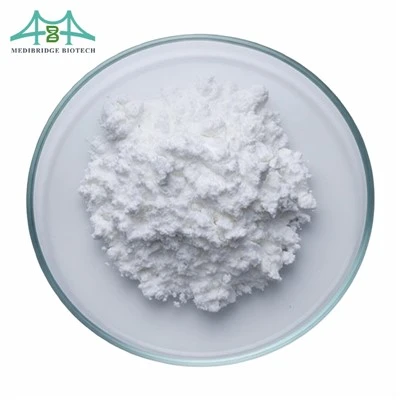
4-Maleimidophenol Powder, as a specific chemical entity, represents a class of compounds in which the maleimide group is covalently bonded to the phenol structure at the 4-position. It has properties of maleimide and phenol. Its thermal stability is noteworthy, allowing it to withstand conditions that promote various chemical reactions without significant decomposition. The molecule is adaptable to multiple chemical and material conditions because of its solubility in organic solvents and its capacity to create hydrogen bonds because of the phenolic hydroxyl groups. Maleimide groups are known for their high reactivity toward nucleophiles, especially thiols, under mild conditions, making them highly valuable for bioconjugation and materials science applications.
This particular structure provides a unique combination of reactive functional groups (maleimide and phenol groups), making it an attractive compound for various chemical synthesis and materials science applications. In organic synthesis, 4-maleimide phenol can be a building block for complex molecules. Its dual reaction sites allow for sequential or orthogonal reactions, facilitating the synthesis of various pharmaceuticals, agrochemicals, and material compounds. In materials science, 4-maleimidephenol is used as a cross-linker to prepare high-performance polymers. Maleimide groups react with free thiol groups in the polymer to form cross-linked structures that exhibit enhanced thermal, mechanical, and chemical resistance.
Shaanxi Medibridge Biotech Co., Ltd. focuses on the supply of pharmaceutical raw materials and research-use compounds. We support customers with stable quality, clear specification communication, flexible packaging options, and document-related support for different project stages.
COA
|
|
||
|
Product Name |
CAS Number |
Batch Number |
|
4-Maleimidophenol Powder |
7300-91-6 |
MB2608080140 |
|
Manufacturer Date |
Analysis Date |
Expiry Date |
|
2026/8/08 |
2026/8/09 |
2028/8/08 |
|
Sample Qty Base |
Packing |
Test Method |
|
650GS |
10GS/bottle |
HPLC |
|
|
||
|
Item |
Standard |
Results |
|
Appearance |
Yellow crystal powder |
Conform |
|
Loss on Drying |
≤0.50% |
0.36% |
|
Residue on Ignition |
≤ 0. 10% |
0.07% |
|
Heavy Metals |
≤10ppm |
<10ppm |
|
Max Single Impurity |
≤0. 10% |
Conform |
|
Total Impurities |
≤0. 10% |
0. 04% |
|
Density |
1.47 g/cm3 |
Conform |
|
Boiling Point |
397°C at 760 mmHg |
Conform |
|
Solubility |
Soluble in DMSO (sparingly), methanol (sparingly) |
Conform |
|
Assay |
98.0% |
98.37% |
|
Conclusion |
The batch conforms to the IN-HOUSE standard |
|
|
|
||


Thiol Addition, Adduct Hydrolysis and Exchange
The maleimide double bond can undergo Michael addition with a thiol, forming a succinimide adduct with a thioether linkage. Fontaine and colleagues showed that hydrolysis of the succinimide ring improved resistance to thiol exchange in the maleimide–thiol systems they tested. This provides a mechanistic basis for studying 4-maleimidophenol. Its reaction rate and adduct stability should be measured for the specific thiol, solvent, and pH.
Quantify the unreacted monomer, initial adduct, and ring-opened adduct separately over time. Tracking all three shows how much starting material forms the intended adduct and how much of that adduct subsequently undergoes hydrolysis.

Monomer Polymerization and Solvent Effects
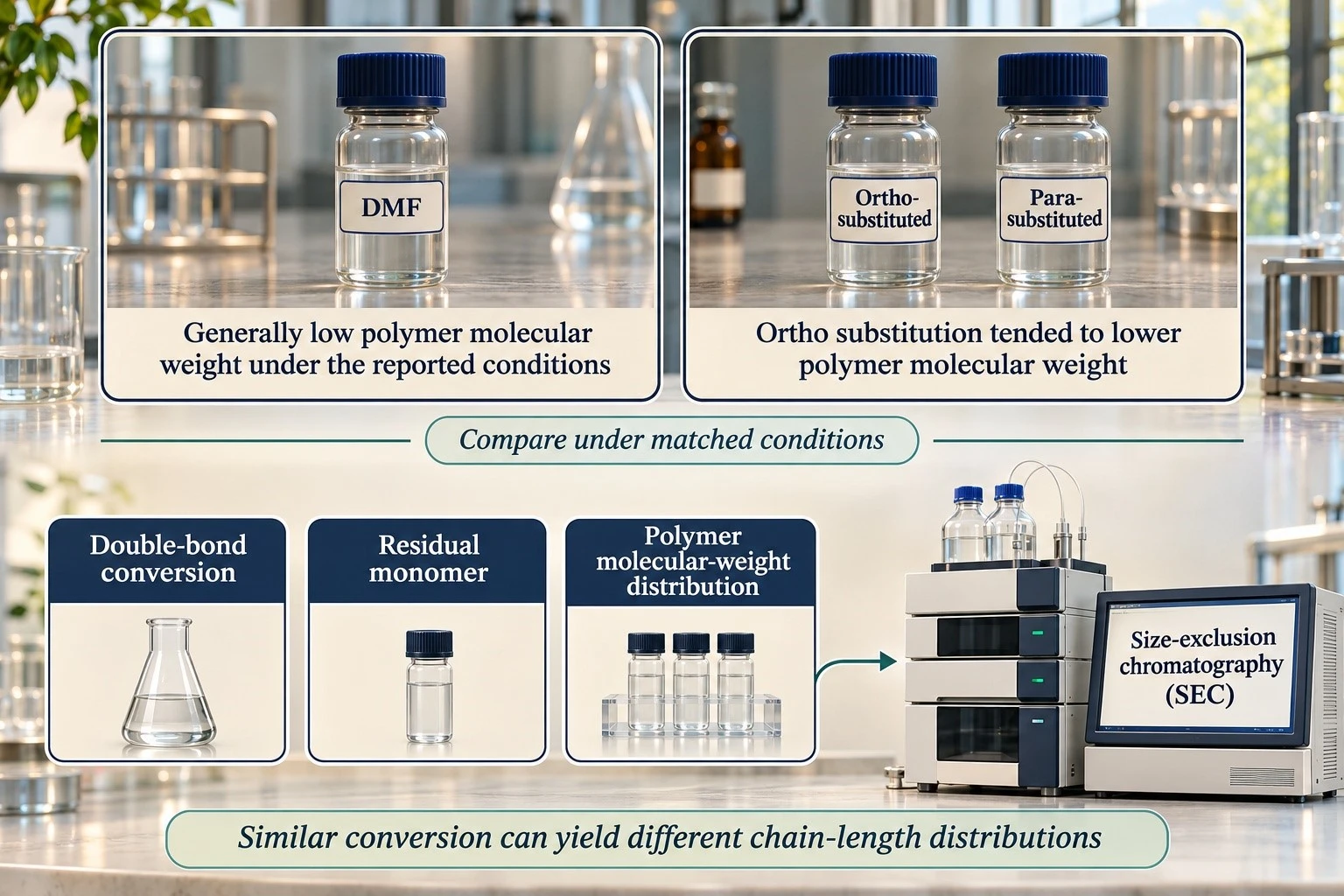
A study of N-(hydroxyphenyl)maleimides found that both the solvent and the substitution pattern on the phenyl ring influenced the molecular weight of the resulting polymers. Polymerizations in dimethylformamide (DMF) generally yielded low-molecular-weight products under the reported conditions. Ortho substitution also tended to lower the molecular weight. These observations provide a basis for comparing the para-substituted monomer with related compounds under matched conditions.
Measure double-bond conversion, residual monomer, and polymer molecular-weight distribution as separate endpoints. Two reactions can reach similar monomer conversion while producing different chain-length distributions. Size-exclusion chromatography (SEC) can help characterize those differences.
Maleimide-Functional Phenolic Resins and Curing
An original study used N-(4-hydroxyphenyl)maleimide, phenol, and formaldehyde to prepare phenolic novolac resins bearing maleimide groups. The researchers reported that curing proceeded primarily through addition polymerization of those groups. This demonstrates how 4-maleimidophenol can introduce reactive maleimide sites into a phenolic resin.
Use NMR or FTIR to assess how much maleimide functionality remains after resin synthesis. During curing, differential scanning calorimetry (DSC) can track reaction heat, while rheology and gel-fraction measurements can characterize network formation. Combining these measurements helps establish how changes in resin composition affect the cure.

Furan Diels–Alder Reactions and Phase Effects

An original study used 4-maleimidophenol in Diels–Alder cycloadditions with electron-poor furans to investigate how a liquid-to-solid phase transition affected the reversible reaction. The study cited a melting range of 182–184 °C for 4-maleimidophenol, above the reaction temperature used. This system illustrates the importance of recording the physical state of the reactants and products alongside temperature and time.
Report reactant conversion, isolated yield, and adduct composition separately. If the adduct precipitates, include both liquid and solid fractions in the material balance. For thermally reversible materials, variable-temperature NMR or DSC can help characterize the adduct's response to heating and assess whether that response is reproducible over repeated thermal cycles.
Side-Chain Functionalization of Ladder-Like Polysilsesquioxanes
An original study reacted 4-maleimidophenol with chloropropyl-functional ladder-like polysilsesquioxanes to prepare organic–inorganic hybrid materials bearing maleimide side groups. One precursor contained 100 mol% chloropropyl side groups. The other contained 50 mol% chloropropyl and 50 mol% methyl side groups. These percentages describe the precursor compositions. The researchers characterized the products using FTIR, multinuclear NMR, wide-angle X-ray diffraction, and thermal analysis.
When comparing curing behavior, quantify actual grafting levels and residual reactive sites before measuring cure exotherms, gel formation, and modulus. These measurements help assess how maleimide side-group density, backbone structure, and the remaining side groups contribute to material performance.

Fluorinated Bismaleimides and Polymer Networks

A study published in RSC Advances used 4-maleimidophenol to prepare a fluorinated bismaleimide and investigated the polymer networks formed from that derivative. The synthesis illustrates how the two functional groups can serve different roles. The phenolic hydroxyl group provides a site for forming the new linkage, while the retained maleimide double bonds participate in subsequent network formation.
When comparing derivatives with different linkers, use 1H, 13C, and 19F NMR to verify the fluorinated monomer structures. Then assess cure conversion, glass-transition temperature, and thermal mass loss. Account for differences in cure conversion when interpreting thermal properties. The published network properties apply to the specific fluorinated derivative and formulations studied.
FAQ
What is the primary application of 4-maleimidophenol in bioconjugation research?
It serves as a heterobifunctional crosslinker used to selectively conjugate thiol-containing biomolecules via its maleimide moiety.
Is this compound soluble in standard aqueous laboratory buffers?
It has limited direct aqueous solubility and is typically dissolved first in water-miscible organic solvents like DMSO or DMF before buffer dilution.
Can this reagent be utilized for site-specific antibody-drug conjugates (ADCs)?
Yes, it is frequently employed to target reduced hinge-region cysteines on antibodies for stable thioether-linked payload attachment.
What safety precautions are necessary when handling the dry powder?
Standard laboratory PPE, including gloves, eye protection, and a fume hood, must be used to avoid dust inhalation and skin irritation.
If you are looking for a high-quality 4-Maleimidophenol Powder manufacturer with whom you can establish a long-term, stable partnership, then Shaanxi Medibridge Biotech Co., Ltd. would be your best business partner. Don't hesitate to contact us at hi@medibridgeapi.com.
Hot Tags: 4-maleimidophenol powder, China 4-maleimidophenol powder manufacturers, suppliers, factory, cobicistat active compound powder, Dicyclanil Powder, Gabapentin Powder, mirabegron therapeutic compound, prilocaine injectable solution ingredient, prilocaine pharmaceutical material